September 30, 2007

Sundays in the Village: It's Your Funeral

Preventing is only postponing

(Revised 01/04/2023) 

Watching The Prisoner in a post 9/11 world is... interesting, to say the least - its themes of individualism vs. collectivism seem at odds with current societal trends. Cameras scrutinizing our every move, once a great evil, are now a staple of reality television. Episodes that seemed cutting edge in the late 1960s, like The General, seem almost curiously outdated. But like many works of art, The Prisoner develops different facets with the onset of years.

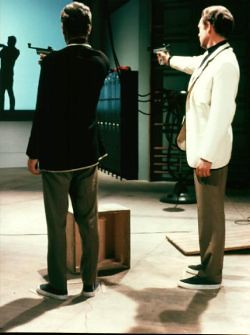
As a result, episodes that might have seemed almost preachy in then-contemporaneous times take on a ripped-from-the-headlines nature in the dawning years of the 21st century. "It's Your Funeral," which may have seemed almost prescient in terms of the assassinations of Martin Luther King and Robert Kennedy, now takes on greater dimensions...especially since, pre-9/11, our president once remarked that there was "too much freedom." From page to stage, this is easily one of the most relevant - and allegorical - episodes in our times.

(EDIT - I may write a later essay for my Patreon page on how this episode - along with Free for All - fit in a post-January 6th landscape

The episode begins with a woman finding her way into Number 6's apartment, and immediately, he suspects a trap. As she relates her tale - her father planning the assassination of a young Number 2 - Number 6 assures her that he'll "listen...as long as what (she) say(s) isn't too obviously phony." In an interesting montage, we see the Young Number 2 listen to a computer-recited itinerary, revealing Number 6's daily agenda. (Which mostly consists of clips from other episodes, in a nice cost-cutting measure). However, we learn that the Young Number 2 is involved with "Plan Division Q", a strategy advised by the pink-jacketed Number 1-0-0 (Not one hundred, but "one-zero-zero"). As Number 6 confronts the Young Number 2 with the plot, we learn about "Jammers", troublemakers who make plans...but who are relatively ineffectual, play pranks, and then ignored. As Number 6 leaves, Number 2 calls his assistant, Number 22 (or "Number 2's number 2) with a plan to discredit Number 6...and take care of a nagging detail....
Older Number 2: "I can think of better ways to die"
Number 6: "...and better causes...to die for"
In the midst of the episode, we are introduced to the sport of kosho - the major pastime of the Village, which involves trampolines, a wading pool, orange jumpsuits, and motorcycle helmets. An unusual martial art seems like the kind of game that two well-known comics bloggers would invent...and more of a diversion.

However, when we next encounter Number 6, he meets with another Number 2 - an older gentleman who seems to share a mutual respect with Number 6. The elder Number 2 shows Number 6 a series of films basically discrediting his "assassination plot," revealing a possible motive - the elimination of the Elder Number 2. (Given that both men seem to have a healthy respect - and with rumors that the series had been conceived of two 13-episode "seasons" - perhaps this elder Number 2 did not consider the rationale behind Number 6's resignation important...hence, the need to eliminate the Elder Number 2).

This is an episode that is hard to explain in summary, mostly because it hits on many themes - we begin to learn that Number 6 has an aversion for innocents being harmed and a distaste for lethal violence. (More on this later...) With its examination of the use of violence in politics, this takes a much stronger stance on the subject than the later "Fall Out". It's move-and-countermove plotting is reminiscent of Checkmate without being derivative, and a slowly creeping paranoia builds throughout the episode. (Chris Carter must have analyzed this episode frame-by-frame) And the greatest call-out of a traitor, the Elder Number 2 stating to this person that "The fact that you won't explain...explains everything," is possibly the best one-line summary of the show ever written.

For the longest time, this was one of my ok-but-not-quite-great episodes. Now, in these troubled times, it looks much more like the masterpiece that it is.

Coming soon: Number 6 quotes Goethe. On being unmutual. Number 6 escapes the Village....and the infamous "lost" episode.

Be seeing you.
September 29, 2007

Blogging About Blogging Is A Sin

to paraphrase a quote from Mike Sterling

As the more astute of you have noticed, my online blog time has been, well, the last time I posted, I think an issue of Planetary had just come out. I've not been as present as I probably could be, and I have a good reason.

My life has been busy. And not in a good way.

Personal matters too numerous to go into online. My personal address book accidentally uploaded into a social networking site...which then began massively spamming personal and professional contacts, resulting in embarrassment. Health scares with my mom and my aunt. But it's left me a little gun-shy around posting in public - my mood has been rather icky, and I've wanted to avoid using the blog (or comments) as a way of snarking out at people.

However, there is one little pet peeve that I'm starting to develop - and that's people who use the comments to complain about problems with links, tags (such as from Rifftrax DIY), and the podcast. I don't mind fixing the blog - I just mind that very little tact seems to be used.

Personally, it's grating on me - it's the equivalent of standing in the middle of the room and yelling, "HEY, GORDON, YOUR FLY'S OPEN!!!" When just as easily, a hushed move towards a corner and whispering the same thing. So I ask that you please e-mail those issues to me in the future - otherwise, it puts both of us into an awkward position.

Also, in terms of the podcast - please keep in mind that I'm doing this strictly as a hobby, and to develop new skills. I'm no professional (and there are plenty of other podcasts that commit worse sins)...and quite frankly, I don't have the financial ability to purchase high end equipment. When I'm in that position, I will...(and it has been suggested that I do a public call for funds. Given that I have no "overhead" on the blog - no domain expenses, or e-mail, or even storage - it seems rather arrogant of me to essentially ask people to pay for reading this blog).

However, I am working on writing a column for a comic-related site (in negotiations - will inform you when it's up and running). I'm also open to any professional opportunities (if you ask nicely, I'll send you my resume).

Again, I know I'll get some flack, but I wanted to be straight - it's been a little rough these past few weeks. It was either come clean or start snarking.

Now, back to your regularly scheduled blog. And coming tomorrow, "It's Your Funeral"

September 25, 2007

Open Letter to Jonathan Ross

Dear Jonathan,

First, I owe you a large debt of gratitude - I was (and am) a huge fan of The Incredibly Strange Film Show, in which you discussed cult movie directors. It was a hard show to watch - mostly because the cable channel sandwiched it very late at night between Kevin Trudeau and Miss Cleo infomercials. But part of my nerd cred comes straight from you.

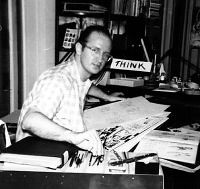
However, this note is not about that, but about your recent BBC4 documentary, "In Search of Steve Ditko". One of my favorite bloggers, Tony Collett of Mah Two Cents, linked to it as it was posted on YouTube, and having some time to spend, watched it.

Quite simply, Jonathan, you've got a masterpiece on your hands. You can now gloat and feel smug and superior over Michael Moore. Or, if you are so inclined, proclaim that you are sexier than Morgan Spurlock.

Much of it is that, as you so articulately put it at the beginning, it's a personal project for you. It's one of the few comics-related documentaries that doesn't make it a crime to enjoy comic books. It also does not take the easy route, especially with a noted recluse like Ditko, to portray him as, well, a "nut job." It's one of the most balanced pieces, especially when dealing with the hot topic issue of credit for co-creating Spider-Man. I also appreciated your deft touch in dealing with lesser known characters like the Question, Mr. A, Hawk & Dove, and the Creeper.

I am sure you will receive notes from fans asking about Shade, the Changing Man, or Blue Beetle, or even Speedball. You know, they're sort of irrelevant to the documentary, which also features some deft interviews. I mean, any documentary that has Alan Moore "rapping" to "Sister Ray is aces in my book. Even towards the end, when you attempt to meet Steve Ditko, is a strong piece of documentary film making.

In the end, this is as good as we will get in terms of a documentary on Steve Ditko. There is a great mystery and intrigue about him, and it should stay that way. The great thing is that most great art endures despite - not because - of great mystery. You did a marvelous job, and am waiting for your next opus: Fred Hembeck - The Greatest Comic Artist Ever.

I would also, if you ever find yourself in Chicago, to please look me up. I would be more than willing to head to an English-type pub and buy you an adult beverage. Or, if you are so willing, a hot dog. I feel that it's the least I can do to say "thanks" for the pleasure you've given me.

Your pal,
Gordon

September 23, 2007

Sundays in the Village: Many Happy Returns

(Revised 01/04/2023) 

This is a hard blog post to write.

The episode is okay - any episode whose first half is primarily silent with top-notch direction(except for four words in German) can't be faulted. Unfortunately, it's an episode that spoils itself through its title. It's also an episode that, plot-wise, never really goes anywhere. Number 6 finds the Village empty, decides to escape, makes his way by raft to London, meets his superiors (and in a nice twist, encounters the guy he resigned to, complete with theme music), and then....finds himself back in the Village.

Only your typical Gilligan's Island episode could be more predictable.

There are a few good moments - in the middle of the episode when Number 6 arrives at (presumably) the White Cliffs of Dover (if you're across the pond, please let me know if I'm right)...as he meets some Romany....and then makes his way to the heart of London, there seems to be the suggestion that he is "out of place", a prisoner without a prison.

The other - Mrs. Butterworth (no, not the former syrup lady, so don't even go there) is a slightly interesting character. Her appearance was "predicted" in a previous story. Although she's an OK Number 2...she's no Mary Morris. We also meet several of Number 6's colleagues, like the Colonel and Thorpe, who may or may not be Number 2 in a future story. I think he is the "Hammer into Anvil" Number 2 - in the espionage world, there may be less than six degrees of separation, and Patrick Cargill's performance here seems to mirror that later role).

However, if you had to choose a handful of episodes to miss, "Many Happy Returns" would be a candidate. It's not a bad episode of The Prisoner - just a so-so one.

Coming soon: Number 6 stops a plot, engages in another plot, and changes his mind figuratively...and literally.

Be seeing you.

September 21, 2007

September 19, 2007

The Story of Torchwood

In all honesty, my mood has not been that great - having had to run my aunt to the emergency room (back problems) on Sunday, dealing with assorted stresses and annoyances (including Blogger glitches, Cuts.com glitches, and some of you out in the blogosphere - expect some tersely written e-mails in the near future. I won't call people out publicly), so blogging has gone to the end of the to-do list.

That is said because I was probably not in the greatest frame of mind to check out the first two episodes of Torchwood. In short, I was not sure I wanted to check out Torchwood, having heard some unflattering and not-very-complimentary things about it. So I sat to watch the pilot - "Everything Changes", and "Day One", and have to say....I was pleasantly surprised. Calling it a "Doctor Who for adults" is kind of insulting; it's more of a stylish, X-Files type of show, creating an automatic aura of mystery and providing a refreshing change.

Of course, that means one of the major networks will 1) try to "Americanize" the show, or 2) do a cheap knock-0ff...which would be the ultimate compliment. Even though some aspects of the show were spoiled (for me) in series three of Doctor Who, knowing those spoilers actually adds to enjoying the show.

The show gets off to a slightly wonky start with "Everything Changes", as Gwen - a member of the Cardiff police force - finds herself getting entangled and involved with the mysterious Torchwood Institute, led by the enigmatic, not-so-happy-go-lucky Captain Jack Harkness. Unfortunately, this Russell T. Davies episode reveals too many of his weaknesses - it views like a pastiche of "Rose"; moments that should seem poignant end up silly (the "estrogen in the rain" speech at the beginning), and at least one moment seems like a total send-up (the scene with Owen and the alien pheromone spray at the bar). However, there is enough of an interest, especially with John Barrowman playing Harkness as a darker character - and as a man of mystery - that makes it a good kick-off for the series. I only wish that this had been written a bit longer - the episode feels like there are some "missing" scenes. The supporting cast provides much more than just scenery - there's a palpable sense of back story in the performances. And I like the take with Torchwood as being almost "above the law" - if U.N.I.T. is the Joe Friday of the DW universe, Torchwood is its Eliot Ness, struggling not to become what it beholds as it deals with extraterrestrial affairs on Earth.

Although the first episode is somewhat awkward, "Day One" - written by Chris Chibnall - works on several levels. Focusing on a girl taken over by an alien gas addicted to orgasmic energy, it also serves as a metaphor - for burgeoning post-adolescent sexuality, for the loneliness that comes after a romantic breakup, and ultimately, for being able to find one's humanity. Gwen becomes more than just, say, the typical Doctor Who companion - Harkness, in fact, dares her to "...remind us...what it means to be human in the twenty-first century." And by this time, the show's sense of humor - snarky, ironic, and quite witty - kicks in, providing some hard-earned levity. In short, I wish this had been the second hour of a two-hour pilot with "Everything Changes"...but that's just me. Even the sexuality of the show serves as a counterpoint - when the gas-inhabited girl begins to kiss Gwen, she hesitates and breaks off, realizing that she "needs a man" - in that moment, we see the bewilderment of someone so focused on being loved, that even a moment of clarity seems painful. I only bring this up because one of the criticisms of Torchwood has been the rampant focus on characters' sexuality.

Personally, Torchwood has a very healthy attitude, given its first two episodes. Contrast this with director Paul Verhoeven,, who seems to demonstrate an almost adolescent misogyny in several of his films. This is the way sexuality on television should be portrayed - not to exploit, or for stereotypical purposes, but to reveal character and connection. For Gwen, having a boyfriend is not just a typical dramatic device - it allows her a degree of connection that the Torchwood team does not. Jack's willingness to engage with anything that's "charming" shows his lack of connectedness with others. (And by "engage", I mean "snog").

If you've seen the entire series, please feel free to suggest which episodes to watch - I have heard that quality dips in the middle. But for something this good, I'm willing to take my chances.


----------------
Now playing: THE CLASH - lose this skin
via FoxyTunes

September 16, 2007

Sundays in the Village: The Schizoid Man

(Revised 01/04/2023)

When last we saw Number 6, he had successfully destroyed a major indoctrination project in the Village. He has repeatedly thwarted the attempts of Number 2 to learn about his resignation. In "The Schizoid Man," the new Number 2 arrives at a very devious, extremely malicious plan - turn Number 6 into a co-conspirator (through drugs, operant conditioning, and other means) and basically break him down through an extended mind game. Or, to quote the episode directly:
"Your job, Number 12, will be to impersonate him (Number 6). Take his sense of reality away. Once he begins to doubt his own identity, he'll crack"
This is one of those episodes of The Prisoner that is something of a mixed bag. If you gave the story a letter grade, it would be a B+, but only because of the last 15 minutes...and ironically, even though it misuses the word "schizoid" in 1960's terms, Number 6 seems to fit the DSM-4 criteria.

(EDIT - looking at the 2023 DSM-5 criteria...possibly still relevant) 

The episode crackles along, with Number 6 and Number 12 (or "Number 6 version 2) playing an unusual game of psychological oneupmanship. The symbolism is sharp (both in terms of who wears which color jacket, as well as Alison or Number 24, "divided" by Numbers 2, 6, and 12), the dialogue crackles (Number 6's insults of Number 12 being from "the people's copying service" and "the economy pack"), and the irony of Number 12 "asserting" that he is Number 6 is subtle. The overall goal seems to begin with "Getting the information from Number 6" (on an "I know something you don't know" basis). Still, as Number 2 so malevolently points out, "By the time we're finished...he won't know whether he's Number 6 or the cube root of infinity". In these terms, the episode is a great example of psychological manipulation.

However, a few things about this episode ring slightly false.

First, this episode uses ESP as a plot point, and I have a slight bias against the use of ESP. Often, it is used as a "magical" device, and given The Prisoner's bias towards realistic science, it is slightly misused here. (There is an alleged "mental link" between Number 6 and Allison; however, given that the dialogue indicates a 68 - 74% success rate in mind reading, all it suggests is that Number 6 should never play poker with Allison). I can believe in the fantastic, whether it is a time-traveling alien in a box bigger on the inside than on the outside or that a ship can surpass the speed of light; I cannot believe that telepathy is given "serious" treatment in this episode.

In addition, the last fifteen minutes are rushed, with various plot points being hammered home in a variety of cliches. (And there's no first-time-for-this-cliche either). It could have used another run through the typewriter; the fact that it leads to a "failed escape attempt" on Number 6's part just seems rushed.

Finally - and this is more of a general complaint - we see a Haitian and (presumably) a Sikh. That's not the complaint - other than those individuals and a female Asian in "Arrival", the Village seems totally non-diverse in terms of its population. Granted, comparing a 1960s show (created by a man born in the 1920s) to 21st-century standards is unfair. Just to put in perspective: at that time, there was a pioneering African-American male in the lead of an espionage drama, a leading co-star in the major hit of the day (which also featured an Asian guest star in its first season), two shows featuring a mixed cast, including a show focusing on young people and one which featured a paraplegic detective.

All of those were "formula" shows, yet demonstrated some movement towards diversity. It's a shame that The Prisoner - focusing on the fear of "one world" - never approached that. Or was it deliberate?

Who knows: after all, “Questions are a burden to others; answers a prison for oneself.”

Coming soon to Sundays in the Village:

“I know every nut and bolt and cog--I built it with my own hands!”

“I understand. The fact that you won't explain . . . explains everything.”

“To borrow one of Number Two's sayings: `The butcher with the sharpest knife . . . has the warmest heart.' ”

"A weak link in the chain of command. Waiting to be broken"


Be seeing you.

September 13, 2007

Paying Back An Old Debt

Some time ago, the inimitable Lefty Brown performed, for me, a valuable public service in talking me out of seeing Catwoman starring Halle Berry. However, in that spirit of good wishes - and as a public service - I would like to pay Mr. Brown back by doing a similar task.

Lefty - you may, at some point, express considerable curiosity at the 1995 Roger Corman-produced version of The Fantastic Four, which was originally made to insure that this producer held the rights. (Of course, it was never intended to be released). As someone who has a high tolerance for pain (I've watched clips of the aborted Justice League pilot on YouTube), I strongly urge you...don't. This movie, "borrowed" from a friend, is a painful, torturous experience.

This is not one of those "so bad it's good" movies, or a movie that has subtle flaws - no, anyone who encourages you to see this movie is saying, "I hate you. I hope you die slowly, an existential death, and making you view this film is probably the most passive aggressive way I can express those wishes. I despise you, lack respect for you, and quite frankly, can show no other contempt for you than to make you watch this movie." In other words, the perfect Christmas present to give Joe Quesada.

But why is this movie so horrible? Well, first they only had a million dollar budget, which was spent primarily on the costumes for Dr. Doom and the Thing. Which is good, because the rest of this movie looks like it was shot in the same office building/warehouse/park complex. It has a script that sounds like it was written on sticky notes , some exasperating leaps of logic (like Latveria being simultaneously near New York and in Eastern Europe), some truly cringe worthy moments (like a tween Sue Storm pining for Reed Richards), dodgy special effects (taken straight from a video game)...to paraphrase Monty Python, this is not a movie for viewing, this is a movie for laying down and avoiding. (Fight scenes, for example, are done with cheap video effects that insult the memory of Ernie Kovacs). It's almost as if the Burton Batman never happened - as a TV pilot, it would be poor trashy camp; as a theatrical film, it's painful.

The acting is pretty much uninspired (or, "hey, it's a paycheck, so I'm not even trying") except for two key roles. The first is the Jeweller, or "The Mole Man Kinda Guy", who combines the presence, charisma, and subtlety of "Grandpa" Al Lewis and Jonathan Harris. But Jay Underwood, as Johnny Storm, makes the most of his role, and "makes the most of this role" is code for "leaves so many teeth marks in the scenery it is not even funny." Comparing the 2005 film to this leaves no comparison; a $50 sock puppet version of this movie would be an improvement. It's also surprising because most Roger Corman productions have a kind of goofy, elaborate charm about them - this is a movie made for the most cynical of reasons, and it shows.

But still, you may think, I need to at least sample this to make up my own mind. In that spirit, I have used Rifftrax DIY to make an MST3K-style mashup of one key scene, borrowed from YouTube. Hopefully, this can help make this wretched, vile disaster of a movie slightly more palatable...but I doubt it.


September 11, 2007

9/11 Commemorative Podcast

Probably a lot crankier than it should be - however, now that I'm mastering Audacity, I was able to cut some of the ums, ahs, and stammers...but my microphone is now sensitive enough to pick up breathing.

(Plus, if the player doesn't work, head here and download the mp3)


Click here to get your own player.

September 10, 2007

Buy Me A Ticket - I Am Sooooooooooo There

OK, here's the new trailer to the Iron Man movie.

If I'm not dating anyone, am willing to be arm candy for those who want to go.

P.S. to Lefty - Purple Rain ahead of A Hard Day's Night? What the heck are you thinking????????????????

September 9, 2007

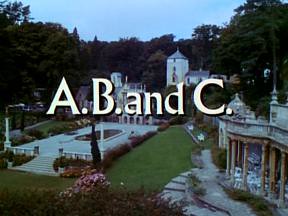
Sundays in the Village: AB&C and The General

"We all make mistakes...sometimes we have to"

(Revised 01/04/2023)

Look at any information on Colin Gordon, and you'll find that he was a standard, hard-working British actor - in fact, his dual stint as Number 2 on The Prisoner is his major claim to fame. However, his Number 2 is very distinct for several reasons, most notably that his is the closest that comes to figuring out the "why" of Number 6's resignation.

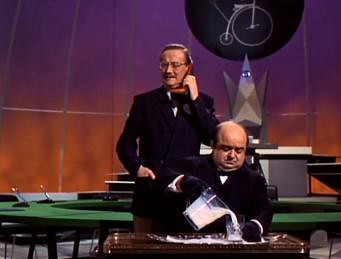
What do we know about this Number 2? He's arrogant towards Number 6 (in the "A, B, & C" pre-episode sequence, boldly announces that "I am Number 2" rather than "I am the new Number 2". However, he is slightly afraid of his superiors - often drinking milk (which he claims is "the perfect food") and looking pensively at the red question-mark-shaped phone on his desk. However, both "A, B & C" and "The General" show that this particular Number 2 is a foreshadowing of one of the major themes of The Prisoner - the use (or misuse) of science and technology.

I had forgotten how fiendishly clever "A, B & C" was as an episode until I watched it again; both foreshadowing character appearances (yes, I know several actors played multiple roles - I like to create my own inner continuity), episodes (such as Number 6 stating "No change of mind," where a later episode will be titled "A Change of Mind"), and contains some sharp directing (notice the A & B sequences, which are straightforward, then the more dreamlike C sequence). Plus, this is the first time a Number 2 has a theory about Number 6's resignation (that the latter was about to "sell out"), rather than a straightforward I-will-break-Number-6 plot. This use of the scientific method suggests that Number 2 is more scientist than spy (and both of these episodes are more science-fiction in tone)

In "A, B & C", we get some very subtle clues about Number 6's pre-Village life. He is a rather restrained yet flirtatious guest who knows people on both sides of the Cold War. By his own admission, he has "never liked secrets", and Number 14 (the female doctor) notices an "anguish pattern" around his resignation. Number 6 has some travel brochures with him and simply states that he plans to go on a post-resignation trip to "Somewhere different, somewhere quiet, somewhere I can think". Given the character assessment in Arrival, I think this is probably the best "theory" as to why Number 6 left his job - he was overworked and needed a break.

But obviously, despite Number 2's "failure" in this regard, he has a much larger - and more important - project to oversee. A project called "Speedlearn". It's stated goal: 100% entry, 100% pass.


"Probably the most important human experiment we've ever had to conduct, and it's treated like a military exercise"
"The General", unfortunately, is not an episode that holds up well upon repeated watching. Many of the themes prevalent - mass indoctrination through media, and lack of critical thinking - are eerily prescient of current times. In addition, we see one symbol - the pallbearer from the beginning credits - explained: it's the "uniform" of the Village equivalent of "civic leaders." It's an episode that, for once, does not focus on Number 6's head - it reveals a slight shift in emphasis. Now, Number 6 makes it his business to destroy the Village internally.

This episode, however, is extremely heavy-handed in handling its theme, its symbolism (Number 12 being "divided" by Number 2 and Number 6?), its attempt at satire, and in drama. In short, it reads like a Rod Serling Twilight Zone pastiche. If they had the budget, Serling could have easily given this a polish between drafts of Planet of the Apes. As it stands, "The General" is not a bad episode per se - it helps us shift towards a broader view of the struggle between Number 6 and the Village. Number 2, as science, sees a device that would have brought about massive influence and achievement of the Village's goals destroyed, even though he sees it as more of a "human experiment". (The fact that the Village sees Speedlearn as "a military exercise reveals much about the malevolence of the powers that be, whether it's "Us", "Them", or "None of the above")

However, the end result is the same - Number 6 has not just defied the Village but has now hurt them. He cannot be ostracized, manipulated, corrupted, or fooled into complying.

From now on, it's no longer a game.

The rules no longer apply.

It's a war between the Village and Number 6.

Coming soon: Number 6 believes in ESP. Number 6 builds a raft. And Number 6 stops a revolution - or does he?

Be seeing you.

September 6, 2007

An Article of Some Interest

Don't let the title fool you - even though it's nominally about gender differences, it's also about literacy, and anything that gets people reading and thinking is way cool in my book.

Why Women Read More Than Men

Today was a good day - two really good job interviews, as well as some general cool things coming my way.

Life is good.


----------------
Now playing: Louis Prima - Sing, Sing, Sing (With A Swing)
via FoxyTunes

September 4, 2007

An Open Letter to Will Pfeiffer

Dear Mr. Pfeiffer (I don't feel I know you well enough to call you Will),

First, I want to thank you for your hard work in comics, and especially your blog. Thanks to you, I have checked out numerous books and movies, and although I have rarely picked up your comics on a regular basis, I am going to start doing so on a regular basis.

Part of it is due to your opening up the blog to comments about Amazons Attack # 6. It takes guts for any creator to hold himself accountable for his work, especially in a public forum - and I respect that.

But more importantly, I want to express how I empathize with you, especially since the comments indicate how you are responsible for 1) destroying Wonder Woman, 2) ruining various other characters by proxy, and 3) getting According to Jim back on the air.

OK, I'm kidding about number 3, but I have to commend you on your restraint. When I started to type this out, I was going to take those who accuse you of "destroying" Wonder Woman to task...actually, I was going to point out that, by using their money to buy a book that they found fault with, that they were responsible for "destroying" the character. No writer or creator sets out to do a deliberately poor piece of work...and you did the best you could. I haven't read Amazons Attack (I'm not a Wonder Woman fan...sorry), but I'm not going to chide you for making a book other people hated.

And quite frankly, their behavior is atrocious. I understand - it's easier to flame and criticize someone behind a keyboard than it is face to face. It would be easy for me to, say, make fun of those who are making homophobic comments, suggesting that several aspects of their character (including IQ) are smaller than normal...but that would be wrong. It just adds to the whole "comic reader = loser" stereotype, and I will not engage in that behavior. I may want to at times, but will strive to do better.

Besides, you're doing what very few creators do - hold back and wait until the firestorm is over, but take creative responsibility for your work. One of your esteemed colleagues, a Mr. Mark Millar, seems to be unwilling to do so (at least, that's how I read the item in Crocodile Caucus). It takes courage to put your work out in the marketplace; it takes even more to humbly accept reasonable criticism. The fact that you're handling all this seemingly well speaks volumes about your character.

Tell you what - from now on, I'll check out Catwoman on a more regular basis. And any other books you may be writing. (Quarter bins, here I come). And if you ever want to get together for a beverage of your choice, please let me know - I'm just two trains and a bus ride away).

Thanks again,
Gordon

September 3, 2007

Happy Labor Day!

Here are your Labor Day presents, courtesy of me, Rifftrax, Cuts.com, the BBC, and YouTube:


September 2, 2007

Sundays in the Village: Chimes of Big Ben

"He can make even the act of putting on his dressing gown appear as a gesture of defiance...I want him with a whole heart, body and soul"


(Revised 01/04/2023) 

According to Wikipedia, "The Chimes of Big Ben" was the original "pilot" for The Prisoner. For the longest time, it was broadcast second (the DVD Megaset places it approximately fifth), and there was an "alternate version" with an extra scene and different end credits.

(EDIT - there's no "official" order to the episodes. If you're streaming on Shout Factory TV or Tubi, you can either watch them in the order they place it, watch along with this blog, or simply mix and match) 

Unfortunately, as a pilot, "Big Ben" doesn't work - there's too much of an in medias res quality. Besides, it revisits several themes from the previous episodes - the nature of the Village, the chess motif, the "democratically elected" committee, and even Number 6 as an outsider. However, as part of the continuing saga, it works - in fact, this is probably the first episode that moves Number 6's story along. We know that it takes place over a long period (six weeks, from beginning to end), and it helps us establish that Number 6...isn't going to leave any time soon.

Of course, it also marks the premiere of Leo McKern as Number 2, who will not return until the concluding two episodes. Until this point, McKern was best known for portraying Thomas Cromwell in the film version of A Man for All Seasons, and/or Clang, the Kali cult leader in Help! McKern's performance reminds me very much of a therapist working with a client - the almost gland handing friendliness contrasted with sheer aggressiveness. McKern's dialogue seems to this seemingly opposing concern and disgust - balancing an analysis of Number 6's behavior (citing the latter's "overweening sense of self-importance" and "egomania...has increased") with a slight sense of care (not wanting Number 6 to become a "man of fragments"; later on, reminding Number 6 that sharp objects are not allowed....perhaps suggesting that Village residents are not even granted the "escape" of suicide?). For this Number 2, learning why Number 6 resigned isn't enough, for "If (No 6) will answer one question, the rest will follow."

Like a poorly trained therapist, Number 2 encourages transference and dual relationships to develop between the two men. No longer is this merely about doing a job - this is personal. As stated in the quote above, McKern Number 2 doesn't just want to get information; he wants to win Number 6 over, almost to have Number 6 become an ally. So much so that Number 2 attempts to goad Number 6 with a Cold Warrior's worst nightmare:

Number Two: I am definitely an optimist. That's why it doesn't matter who Number One is. It doesn't matter which "side" runs the Village.
Number Six: It's run by one side or the other.
Number Two: Oh certainly, but both sides are becoming identical. What in fact has been created is an international community — perfect blueprint for world order. When the sides facing each other suddenly realize that they're looking into a mirror, they will see that this is the pattern for the future.
Number Six:The whole Earth as the Village?
Number Two:: That is my hope. What's yours?
Number Six:I'd like to be the first man on the moon.
Of course, Number 6 is overt, whereas Number 2 is covert, casually announcing that he desires to "Escape, come back, wipe this place off the face of the earth, obliterate it...and you (Number 2) with it". It would not be surprising if this Number 6 came back later for a face-off...

Of course, this episode is also the one where Number 6 comes closest to having a female companion. (Of course, the highly moral and devout Catholic McGoohan didn't believe in romantic relationships on screen). Nadia or Number 8 (in a coincidental nod to the last woman Number Six was involved with) becomes Number 6's...well, Number 6's relating to her eerily parallels the way McKern's Number 2 relates to Number 6. And during this time, Number 6 pulls off a massive hoax - building a boat in plain sight and making another escape attempt. He succeeds...or does he?

Even though there's a seemingly circular nature to Number 6's attempt, later episodes may show that that would be telling. But "Chimes of Big Ben" starts increasing the tension, ratches up the overall arc, and further engages the viewer by matters left unquestioned.

Too many "embarrassing questions," as his superiors point out, Number 6 hinting that his resignation was "a matter of conscience," and the seeming omnipresence of the Village....create the sense of intense back story, and this episode helps bring the viewer into the greater question - and the premise - of The Prisoner:

Why did Number 6 resign? And...what else might he possibly know?

Coming soon: A Number Two two-fer. Number 6 meets "the economy pack." And introducing Mrs. Butterworth.

Be seeing you.

September 1, 2007

September's Record You Should Own

Just in time for your labor day listening - September's Record You Should Own

Also, just a few notes:
  • I had to delete one of the earlier, less professional sounding podcasts, to make room.
  • For some reason, posting the MP3 took forever, hence the deletion. Please let me know if there are problems.
  • Cranking up the gain on my microphone does wonders!
  • There's a wacky prank that you can join in...and
  • Get ready for a major "Sunday in the Village" post tomorrow. I'm seriously considering collecting my Prisoner posts and writing them as a book.
  • NOTE: the embedded player may not be working right - click here to listen if needed


Click here to get your own player.