Showing posts with label books. Show all posts

November 22, 2016

Review: Steve Bellinger's THE CHRONOCAR


(Note: this review originally appeared in Goodreads; a complimentary copy was provided for review)

To be honest, I started The Chronocar shortly before the election...and couldn't quite get into it. Traveling back and forth downtown the next day I managed to read it through both trips on the Midway Orange Line.

Steve Bellinger's The Chronocar is a really good, brisk science fiction novel about time travel...but its focus is on the African-American experience. When Tony, a student at IIT, discovers a paper about time travel by a man who lived almost a century before, he decides to build the machine and see things for himself... ...and that kicks things into motion.

 It's hard to discuss the actual plot without spoiling it, but one of the great things about The Chronocar is that it addresses the usual tropes of time travel fiction...but it also provides insight into the African-American experience both currently and in a "less enlightened" time.

Centering around a little-known historical event, The Chronocar defies many expectations - the plot moves along at a brisk pace, tropes are used in creative ways, and the ending contains a twist worthy of The Twilight Zone.

Although I would categorize this book as a Young Adult novel, there are elements here that can please anyone. The Chronocar is a short, brisk, entertaining read that deserves a place on your bookshelf. After you've read it, of course. :)

August 16, 2016

I Know Cool People: Andy Martello's THE KING OF CASINOS Audiobook


Remember when I asked all of you to purchase pal Andy Martello's The King of Casinos?

Well, you may be so busy that you either forgot....or you don't have time to read.

Don't worry - it's now available as an audiobook via Audible.com

Now you no longer have an excuse.


February 20, 2016

UP FROM WHERE WE'VE COME: A Must-Read


Musician Charles Wright is best known for his 1970 song, "Express Yourself"...and he's taken his own advice in writing his memoir, Up: From Where We've Come

Although I must disclose that I received a complimentary electronic copy for review, I'm glad I took on the assignment, because Up From Where We've Come is one of the best memoirs I've read in awhile.

First, I enjoy reading about the small, more personal takes on history, and this is where Up From Where We've Come shines. Wright structured his book as a series of small vignettes, but these vignettes craft a very intricate portrait. Starting from his experiences of something that happened before he was born to his family's move to California, Wright explores his experiences as a child in the deep South.

While discussing his youthful experiences, Wright doesn't pull punches. For those seeking a smaller, more intimate exploration of the African-American experience, Wright shares in a direct, honest way. Up From Where We've Come has several stories where heartbreak and pain are prevalent. (There's a scene involving Wright, his brother, and a turtle that will soften even the hardest of hearts). Even when describing experiencing racism in the South, Wright provides a matter-of-fact tone that neither condones nor condemns.

But much of Up From Where We've Come is a sheer joy to read. Wright gives his tale warmth, humor, and refreshing surprises. (Like an introduction by Little Richard). Up From Where We've Come is one of the best things I've read this year, and is definitely worth reading.

Up From Where We've Come is supposed to be the first volume in a series of memoirs by Charles Wright....and I'm looking forward to the next volume.

December 5, 2015

THE AUTOBIOGRAPHY OF JAMES T KIRK - A Review

Although Star Trek was my introduction to fandom and genre television....recently, I've had a reluctant relationship with the franchise. No, it's not that I feel negative sentiment towards either of the JJ Abrams films, but I'm tired of the blatant cries of "it's not the Trek I grew up with"....and the unnecessary hero worship of William Shatner. In fact, I approached The Autobiography of James T. Kirk with some reluctance, expecting professionally written fan fiction.

Ironically, David A. Goodman's work makes this book a pristine example of Trek done right....and more importantly, helps redeem the franchise - and its more vehement critics - in my eyes.
In terms of spinoff media, it reflects Greg Cox's three books in the Eugenic Wars saga in its mix of clever narrative and clever references. Unlike the Eugenic Wars saga, The Autobiography of James T. Kirk is a much more straightforward narrative, serving as Kirk's "memoirs" shortly before the events of Star Trek: Generations.

Goodman does a clever job of mixing both Trek-references (with heavy dollops of Star Trek: The Original Series) with some clever interpretation and elaboration. With Kirk relating many "behind the scenes" anecdotes behind several stories (and a clever handling of Star Trek V: The Final Frontier which is better read than described), this book tells the kind of story Trek does best: using futuristic concepts to tell a very human tale. James T. Kirk is no longer the swashbuckling hero we're familiar with, but a man who regrets some of his choices, and possesses enough self-awareness to attempt moving forward.

To be honest, I needed a bit of an escape from the past week and a half (Mom's health issues striking hard after an especially rough Chicago TARDIS), and this book hit the spot. It's an easy read, has plenty of great references, and quite honestly....probably the greatest piece of fan appreciation I've ever read.

It's a must-read.

November 28, 2015

Comedian In Twilight: RAISED EYEBROWS

As you're reading this, I'm currently working a large convention of fans....and some would believe that I am "living the dream." But that does a great disservice...and for some, "living the dream" can be a mixed blessing.

Steve Stoliar was one such person - growing up as a Marx Brothers fan, he jumped at the chance to live and work with Groucho Marx in his later years. It forms the backbone of his recently reissued memoir Raised Eyebrows - My Years Inside Groucho's House (Expanded Edition), and also makes for some great, compelling reading.

If you're looking for sordid details and/or a hatched job....look elsewhere. This isn't the book for you. In fact, Stoliar does an exceptional job in providing a balanced  yet realistic look at life with Groucho in Raised Eyebrows. Stoliar came at a time when Groucho was embroiled in both a controversial relationship (with Erin Fleming) as well as a comeback (the Marx Brothers' "revival" in the 1970s). This could have made for an explosive, spare-no-details expose that would not be out-of-place in our TMZ-and-gossip-driven media culture.

But Stoliar doesn't do that - in fact, Stoliar makes great efforts to provide balance in Raised Eyebrows.  Consistently taking the high ground, Stoliar frequently sites that he may not have known all the details in a given situation, and more importantly, rarely descends to innuendo and character slamming. (Towards the end, Stoliar even relates details about some issues various individuals took with his memoir).

It's the kind of book rarely seen - an honest, open look at someone meeting the focus of their fandom....and seeing them as a human being. And that's the best reason to read Raised Eyebrows.

That, and Stoliar's story about Zeppo Marx as a romantic rival.

Highly recommended.


November 4, 2015

Review: BIG STAR: NOTHING CAN HURT ME and A MAN CALLED DESTRUCTION


Like many people who grew up in the 1990s, I became enamored of the music of Big Star - mostly through word-of-mouth testimonials. (That Replacements song about Big Star's Alex Chilton didn't hurt, either) So I easily fell in love with the sensitive, shimmering songs of #1 Record, the harder-edged-yet-brittle Radio City, and the flat-out darkness of Third.

(And if you don't find yourself repeatedly listening to September Gurls after hearing it the first time, there's something seriously wrong with you)

But the band's legacy has been explored in detail within the past two years, with the 2013 documentary Big Star: Nothing Can Hurt Me and Holly George-Warren's biography of Alex Chilton, A Man Called Destruction: The Life and Music of Alex Chilton, From Box Tops to Big Star to Backdoor Man . Both are invaluable guides to how one man pursued his creative vision....descending into self-destruction and then a kind of redemption.

Of the two, Big Star: Nothing Can Hurt Me is the more revelatory piece about Alex Chilton, with its sole focus on the band and its limited output. It's a story about how a small studio gained slight prominence, bringing in local talent and fostering a sense of community. It's about two polar creative opposites finding their way into collaboration. But most importantly, it's about the output - there's a great mix of testimonials and actual music that shows why Big Star gained the hearts and minds of many people. (It's almost as good as the Replacements documentary Color Me Obsessed).  It shows why, for a band relatively unheard in its own time, Big Star has an appeal for many people....

....and A Man Called Destruction places it in the overall context of Alex Chilton's life. Granted, she starts with a little too much detail (did we really need to explore the history of the Chilton family?), but Holly George-Warren does a splendid job of highlighting some of the various aspects that drove Chilton: unusual parenting styles, the death of a sibling, the effects of early stardom as lead singer of the Box Tops - all of these factors influenced some of Chilton's later behavior.

If there's one complaint about A Man Called Destruction, it's that there's never really a sense of Chilton as a person. Of course, perhaps the idea that Chilton was so erratic in his career, and that his musical choices were a bit....eccentric, to put it mildly. (To paraphrase a Paul Westerberg quote, Chilton was either a massive genius or a guy who lost it a little too quickly).

Long ago, I used to have a Record You Should Own podcast, which I gave up due to personal commitments. Big Star has a prominent place in my top recommendations, and both Big Star: Nothing Can Hurt Me and A Man Called Destruction provide great justification for that reputation.

Read and watch both.  And you'll never again travel far without a little Big Star.


August 24, 2015

Want to Join THE LEAGUE OF REGRETTABLE SUPERHEROES?

Throughout the history of comics, there have been characters who...well, may not have been well-developed. Who may have been created in a flash of inspiration, but further follow up....well, just didn't happen.

Several examples have been collected and described in Jon Morris' The League of Regrettable Superheroes: Half-Baked Heroes from Comic Book History from Quirk Books, a great history of those character who might not have been popular....but who had a great spark of genius to them.

Arranged in an encyclopedic format, Morris' book focuses on three distinct - and the usual - eras of comics (Golden Age/Silver Age/Modern). However, The League of Regrettable Superheroes does something very few books like this would do - treat the characters with a modicum with respect.

(And yes, there are obligatory references to Fletcher Hanks, thank you very much)

One of the only complaints I have about the book is that it's a relatively easy read...but that's much of the point of The League of Regrettable Superheroes. There's a charm and a lightness of touch that makes this one of the more enjoyable aspects of the book. (Oh, and if you're expecting rehashes of Morris' blog Gone and Forgotten....you would be mistaken.)

But if you're looking for a great end-of summer read that provides some insight into some....not-quite-wannabes, or even a serious effort to look at some of the more esoteric characters in comics, my suggestion is to check out The League of Regrettable Superheroes.

You'll thank me later.

July 30, 2015

SOMETHING STRANGE IS GOING ON With Fletcher Hanks....

By all accounts, comic writer/artist Fletcher Hanks was a mystery...and an oddball. His work during the Golden Age of Comics (reprinted in I Shall Destroy All The Civilized Planets! ) has a very distinctive, erratic quality. It's not a hyperbole to claim that once you read it, you will always remember it for its unusual tone...

...and it's that very tone that Flinch Books takes in its anthology of Fletcher Hanks-inspired prose entitled Something Strange is Going On!: New Tales From the Fletcher Hanks Universe Don't be misled by the title or its potential campiness: there are some really good, outright strange tales in this collection, and it's well worth checking out.

(Note - it's only available as an ebook, but you can always use the Kindle App for Android or iOS, or even Kindle's Web Reader).

It's hard to single out one story because....well, they all contain Fletcher Hank's uniquely surreal tone. (Think of Roky Erickson if he wrote/pencilled/inked comics in the 1930s rather than start a psychedelic band in the 1960s). Edited by Jim Beard (with whom I have worked via Airship 27), Something Strange Is Going On features a variety of characters from Hank's distinctive imagination, including Stardust, the Super-Wizard; jungle heroine Fantomah, and boxer Moe M. Down.

(No, I'm not making that last one up. Quick sniggering).

You may be wondering if I've suddenly turned hipster on you, and promoting something that's so bad, it's good - far from the truth. One of the great things about Something Strange Is Going On is how each tale manages to balance Hank's eccentricities with solid storytelling. It's the kind of book that you can't imagine yourself enjoying....yet it becomes one of your favorite hidden treasures.

Flinch Books is doing something very intriguing: taking the public domain work of a little-known artist and making it available via new stories. Managing to capture the unique tone and flavor of Hanks' characters, Something Strange Is Going On is one of the more unique reading experiences you will ever have.

Buy it. Read it. Now.


April 14, 2015

From Page to Screen: GOING CLEAR


Admittedly, I've always had a slight scholarly interest in Scientology...not enough to consider being audited, though. I was first exposed to its ideas via a book at the local public library....and even as a child, I was confused as to what it was. So when Lawrence Wright's book Going Clear: Scientology, Hollywood, and the Prison of Belief was released, I eagerly checked it out of the library. When HBO announced and broadcast its accompanying documentary, I had to see it (especially since Alex Gibney, one of my favorite documentary directors, also had a hand in its creation).

I'm glad I did, because both the book and the movie are really powerful explorations of a very controversial movement.

Both share a similar structure, focusing their first half on the history of Scientology under L. Ron Hubbard, and the second half on the leadership of David Miscaivige. Both the movie and book take great pains to maintain a sense of neutrality about the Church. (Wright suggests that several people who have left Scientology haven't necessarily denied its teachings - just that those in charge may be abusing power). In exploring Scientology, both Going Clear the movie and the book touch on many key issues: what exactly is a religion? What happens when someone may invest himself too much into his own belief system? And finally, what kind of behavior can - and should - be tolerated in a religious order?

 If you're thinking that you will choose to avoid Going Clear because of perceived support of Scientology....you're missing out. Neither condemning nor condoning, both the book and movie have a just-the-facts manner about them. As people tell their stories (both the book and film use some of Hubbard's own documentation), there's an uneasy sense that something rotten lies at the heart of a belief system. It would be easy for Going Clear to turn into a smear job - the fact that it skirts around some potentially litigious material shows the amount of restraint used to bring these matters to light.

There's a good reason why Going Clear is receiving such attention - Lawrence Wright wrote a very plain, just-the-facts-oriented book, which provided the basis for Alex Gibney's similarly-themed film.

Read the book. See the movie. Don't worry about one spoiling the other - you'll enjoy both.

March 30, 2015

Introducing the War Doctor: DOCTOR WHO - ENGINES OF WAR

You know, when The Day of the Doctor was first transmitted, I have to admit that I loved the character of the War Doctor (as played by John Hurt). He was not only Moffatt's semi-ironic commentary on Doctor Who, but also provided a glimpse into the Doctor's worst nightmare. (To put it simply, it said in 77 minutes what all of Series Six tried to say....badly). So when I heard that Doctor Who: Engines of War would feature the character, I eagerly purchased the book and read it thoroughly.

Written by George Mann, Engines of War concerns the events preceding Day of the Doctor (from the War Doctor's perspective), and is....well, it's a heckuva ride. Many fans cite the Virgin New Adventures as being "adult Who" (If you're curious about Doctor Who in book form, might I suggest The Doctor Who Book Club Podcast?), but Engines of War really is mature without being pretentious about it. The Doctor (or, as the Daleks refer to him, "The Predator") finds that the Daleks have a superweapon, and are planning a last ditch effort to end the Time War....

....which, of course, the Doctor decides to end by warning the Time Lords. However - and this is Mann's masterstroke - we see a civilization that is, as the Sixth Doctor might put it, "decadent, corrupt, and rotten to the core." One of Mann's deft touches is how he suggests this corruption - as well as the nature of the Time War - in simple yet disturbing terms. (There is no overt gore, but some of the more terrifying elements would not be out of place in a Hinchcliffe/Holmes production). With a one-off companion named Cinder (who actually made it into the Doctor Who: Legacy mobile game), the War Doctor actually is much more Doctor-like than we've seen. (Of course, there's also some added ruthlessness and crankiness - after all, this is a man who refuses to refer to himself as the Doctor). But one of the great things about Doctor Who: Engines of War is that it provides a strong read and a unique take on the Doctor - so much so that I wish this were "canon".

(It's actually so good, I'll be checking out some of Mann's other, non-Who work. If he can handle a franchise this well, I can only imagine how he would handle his own creations....)

It's going to be a long wait until Series Nine in August/September....so one good way to ease the wait is to pick up Doctor Who: Engines of War. You'll thank me later.


February 5, 2015

Surviving Snowmageddon: ALL TIMELINES LEAD TO ROME

At last year's Windy City Pulp and Paper, I was fortunate enough to receive some complimentary books from author Dale Cozort, with the promise of reading and reviewing them. Needless to say, I hadn't had a chance to read any of them until this past Sunday's Snowmageddon 2015. Sitting down with All Timelines Lead to Rome - a book that was highly recommended by friends - I spent a few hours (after shovelling snow) reading the book from cover to cover.

I'm glad I did, because All Timelines Lead to Rome is a really good read.

I'm a sucker for a good parallel world story, but All Timelines Lead to Rome doesn't focus on that parallel world exclusively. Like Doctor Who: Inferno, Cozort's book uses a parallel world as a storytelling engine rather than a primary setting. Splitting between our present world and "Timeline X", Cozort's story focuses on a central mystery: a corpse is found with a photo of a scroll from a parallel timeline. With concerns about polluting a parallel timeline, Darla Smith - an agent for the Bureau of Temporal Integrity - leads an investigation that results in uncovering a rather fiendish - and possibly deadly - conspiracy....

One of the great things about All Timelines Lead to Rome is that it's a strong thriller with slight science fiction overtones. There's never a false beat or obvious storytelling trick, and there's a wonderful sense of pacing. (It also helps that Cozort actually makes the western suburbs of Chicago seem exciting - trust me, I've been out there). Even the nature of Timeline X is unique - a world where Rome maintained its empire, and America remained a hidden land, its indigenous people remaining untouched by "civilization".

All Timelines Lead to Rome also demonstrates a great deal of depth and diversity, both in its research and in how it describes its characters. When the final revelations come (and no, I'm not going to spoil), there is a very palpable sense of shock. Even though various characters may seem familiar, there's never a sense that the plot follows familiar cliches. Cozort does a great job in writing a story that's half thriller, and half exploration around how cultures are influenced by various factors.
If you're looking for a really good, casual read - consider All Timelines Lead to Rome by Dale Cozort. My only regret is that I didn't read this sooner....but now, I've followed through on at least one obligation from last year.

And now, onto those Sanctum Press Doc Savage and Avenger reprints I purchased....

January 26, 2015

An Alternative History: THE MAN IN THE HIGH CASTLE

Note: this blog has an affiliate relationship with Amazon.com, and we do get a small commission if you click on the link and order products.

Unlike many other streaming video services, Amazon.com is providing some of its series in total (think Transparent) and others are being presented as part of Pilot Season, allowing people to watch and vote. One of the options is an adaptation of Philip K. Dick's The Man in the High Castle [HD] , produced (in part) by Ridley Scott.

Its first episode is being streamed for free, and I heartily recommend you view it. Not just because it's free, but because it's pretty sharp, well-written television.

Based on the novel of the same name, The Man in the High Castle focuses on an alternate world where the Axis Powers won World War Two....and we catch up with American life in 1962. America is carved up into three zones - the Nazi occupied East, the Japanese-occupied West, and a "neutral zone" along the Rocky Mountains. The series focuses on two people - a  man hired for a mysterious cross-country trip, and a woman who meets her sister after years of separation....and both find themselves dealing with a mysterious film can with the title The Grasshopper Lies Heavy. Life for people in this world is gray, and dour, and - admittedly - trying: the episode opens with a film reel of typical American scenes, and the reel ends with an American Flag - with swastika - and the words "Sieg Heil".
Admittedly, this isn't quite feel-good television fare, but it shouldn't be - as a kickoff episode (Amazon's encouraging people to vote this episode up or down), there's enough in The Man In the High Castle to encourage further episodes. Enough is set up in this parallel world to warrant further exploration. Admittedly, there's a washed-out quality to the production (shot in England and Seattle, there's a grayish quality throughout the production), and it may not necessarily seem like easily accessible fare (some nice action-adventure elements are added to the story), but it's a nice, almost casual examination of a world of "everyday evil", as Graham Parker might say....and thankfully, there's no obvious political overtones (meaning - if you're looking for the show to condemn those on either side of the aisle, there's no obvious metaphor for either.). It's a thoughtful examination of the "people after the apocalypse" trope that views like The Walking Dead with Nazis instead of zombies.


...and if you're looking for a comparison with the Phillip K. Dick novel, there really isn't much of one. Both take place in a similar history, but Dick's novel is much more of a meditation on the influence of chance, on the nature of being "authentic", and on the everyday evil that permeates regular life. (The book refers to the I Ching more frequently than the 1896 storyline on Dark Shadows). It's an examination of people living in the aftermath....and although both involve a work of art titled The Grasshopper Lies Heavy, the way that art is handled in both reveal levels of meaning. In Dick's novel, The Grasshopper Lies Heavy is a "banned book", and part of the plot involves meeting the author to determine just how he came to visualize such a world. In Amazon's Man in the High Castle, it's an illicit newsreel - a visual representation of what might have happened (in Dick's book, the "Allies won" timeline differs from actual history) - that kickstarts the narrative.

Either way, both the pilot episode of The Man in the High Castle - as well as Dick's novel - are worth experiencing. Since the pilot is free for Amazon members, it's definitely worth checking out.

As far as the book, there's always the local library.

January 6, 2015

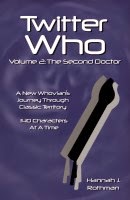
Review: TWITTER WHO Volumes 1 & 2

As winter hits hard in Chicago, my thoughts go back to November....and Chicago TARDIS. Working the silent auction, I was fortunate enough to meet Hannah - a really cool volunteer who seriously rocked an Osgood cosplay.

(Side note - men my age should never, under any circumstances, use the phrase "rock the **** cosplay).

When she handed me a card promoting her books which were compilations of live tweets of classic Doctor Who episodes, I was intrigued enough to purchase Volume One of Twitter Who via Smashwords. That led to me Volume Two (focusing on the Second Doctor), and quite honestly - these are must-reads for any Doctor Who fan.

You're probably thinking "Why should I read live tweets of shows I already watch"? Much like pal John of Comic Related (who performs the same task with Agents of SHIELD), Hannah Rothman takes a very pointed, snarky - and fun - look at classic Who. In a fandom where several people take themselves way too seriously (a friend of mine nearly lost his stuff because I was bad at Twitter math), Hannah does a really good job at highlighting some aspects of early Who....especially since much of these episodes are only available as reconstructions.

(Plus, she had me at Made of Walruses. You're going to have to purchase the books yourself to get the joke).

Another cool thing about both books is that they're published through Smashwords - it's a self-publishing platform that provides a great deal of books. (My publisher, Pro Se Productions, and pal Mike Luoma have used the platform in the past). You're able to get the books in a variety of formats, including PDF (for those of you who may not have tablets). There's even an online reader - even if you don't own any kind of device, there's a nice flexibility to the platform that I'm really liking.

Seriously, though - Volumes One and Two of Twitter Who are really good reading, especially for non-Who fans. I think you'll get a kick out of both (and can't wait for Volume 3).

December 16, 2014

Remembering Phil Hartman: YOU MIGHT REMEMBER ME

To be totally honest, I didn't really care for Phil Hartman's work.

In light of the circumstances around his passing, that's not the most endearing sentiment to have. Words like "genius" and "talent" get thrown around....but except for his work on NewsRadio, much of his work left me cold. It didn't help that SNL was approaching what it eventually became - a middlebrow "live" show that went off like clockwork without any sense of creative anarchy. So I approached reading Mike Thomas' You Might Remember Me with great curiosity, but not with great enthusiasm

The result: Mike Thomas presents a very intriguing portait of a man who may have been more comfortable portraying fictional characters than in his own skin.
In many ways, You Might Remember Me reflects HBO's Life and Death of Peter Sellers - both men seemed adept at playing a variety of characters, and whose personal lives had a great deal of turmoil. Thankfully, Thomas practices a great form of discretion with Hartman's life - it's a warts-and-all portrait that feels all the more human. Granted, Hartman led a more varied life than most people - starting as a graphic artist for record covers, early involvement with the Groundlings, moving onto television and (seemingly) progressing as a solid character actor.

When the tragic end comes, Thomas pulls no punches...but he also gracefull describes the aftermath and loss. (It's to his credit that Thomas doesn't dwell or speculate on what happened the night of Hartman's death, but provides as much detail as he reasonably can).

In the end, part of the frustration with You Might Remember Me is that Thomas' subject was also....well, tough to get to know. This isn't meant as a criticism of the book, and to Thomas' credit, he paints a pretty vivid portrait of Hartman's life. You Might Remember Me is a relatively brisk and easy read, but it also feels a bit unfinished....but since the book portrays an actor who was always on a quest for identity, that isn't a drawback - it's part and parcel of the narrative, and definitely worth exploring.
Highly recommended

August 19, 2014

Linux-Flavored Noir: DARK DIGITAL SKY

His name is Chaucer, but he prefers to be called Chalk - he's a private investigator who is literate, familiar with the world of coders and hackers, and who has a bit of a problem playing nicely. He also finds himself caught in a very elaborate scheme which begins with a man attempting to track down his heirs...ones conceived via a special kind of bank.....

That's the premise of Carac Allison's Dark Digital Sky, a novel due to be released in mid-September. (I was lucky enough to receive an advance copy for review). This is a very sharp, extremely intelligent hard-boiled mystery that mixes great high-end concepts with traditional pulp-flavor. Imagine Mickey Spillane and Daniel Suarez as co-writers, and you'll get a sense of Dark Digital Sky's tone.

It's a very nice, well-paced plot, with Chalk making some nice, well-written soliloquies in between moments of detection. But these aren't literary indulgences - they help make the plot move along at a steady clip. In fact, the plot moves like a well-coordinated game of three-card monte, manging shifts in plot that never seem artificial or forced. Dark Digital Sky also integrates aspects of 21st century life, coming up with very clever takes on military matters, law enforcement, and even literature and movies that never seem self-indulgent.

Dark Digital Sky is a book that's too good to spoil, with a plot that runs like clockwork, characters that feel fully formed, and an atmosphere that simply envelops the reader. It also does what other favorite authors like Spillane, Robert B. Parker, and Jim Thompson do best - make me wish the next installment were out already.

Dark Digital Sky is probably the closest we'll ever get to a model of "geek noir." It's a must-read for anyone looking for a distinctive, unique literary voice....as well as an entertaining read.

August 9, 2014

I Know Cool People - Buy THE KING OF CASINOS

I'll keep this amazingly brief, because - let's face it - things have been a bit hopping for me in terms of looking for work, writing, etc.

Ordered Andy's book The King of Casinos: Willie Martello and The El Rey Club, and read it from cover to cover.

Sheer brilliance from cover to cover.

It's a story about a small casino in a small Nevada town, and the owner who had some big ideas. It's a nice, breezy read chock full of some great anecdotes and insights into a time long past. (I wouldn't expect Andy to suddenly write like, say, Dostoevsky...he's the kind of guy who believes Chekhov's gun refers to the fact that, if you show a gun in Act 1, you use it to shoot Ensign Chekhov). It's the kind of book that reads like fiction....but it's all based on fact.

I can't say enough about this - it's a great read. Go buy it. click on the photo below. You'll thank me later.


July 28, 2014

Dining With a Genius: MY LUNCHES WITH ORSON

Recently, I've been doing "research" into Orson Welles - mostly, it's because I'm writing a Black Bat story for Airship 27 (and yes, I have read their past collections), and Welles....somewhat informs the story. That's meant rewatching his films (including revisiting personal favorite The Third Man and renewing my love of The Stranger)...and purchasing a copy of Peter Biskind's My Lunches With Orson
Consisting of a series of lunch conversations between Welles and filmmaker Henry Jaglom, My Lunches With Orson focuses on Welles' final years, giving us a glimpse of a filmmaker struggling to get his work financed, and well beyond the "Paul Masson" years.

If you're looking for a concise explanation of the art of filmmaking....you may not find that here. If you're looking for the beginnings of independent cinema, and of the almost entrepreneurial spirit a director has to have to complete their vision....you will find that here. If you're looking for straightforward, near-gossipy talk about Hollywood icons during the "golden years"....you will definitely find it here. Lunches really captures an honest glimpse of a man known for misdirection and conjuring unique images with his guard down. (One condition of Jaglom's lunches were that he would record Welles, but keep the recorder out of Welles' sight).

Legend has it these tapes were kept for over thirty years, and were only recently found, transcribed, and turned into the book. Thankfully, My Lunches With Orson is organized into short, pithy chapters that never feel like they outstay their welcome. It's the kind of book that Roger Ebert would have championed - a rare glimpse into a writer/director's thought patterns that makes lofty concepts accessible. It's a breezy read (especially if you're using a tablet/e-reader), and quite honestly, deserves a place on your shelf.
If you enjoy great filmmaking or seek writing which is brutally honest about Hollywood without having the tinge of tabloid spirit, you definitely want to check out My Lunches With Orson.

(And if you're seeking more pulp-centric fare, why not check out both volumes of Airship 27's Black Bat Mystery and Altus Press' Black Bat Omnibus Volumes One and Two? At the very least, you can read about a crimefighter who dresses like a bat who is not named Bruce Wayne....)

June 26, 2014

Review: BLACK PULP

(First, in full disclosure - I have some stories to be published by Pro Se Publications, but that has not influenced my opinion one way or another - my opinions are my own)

One of the many issues my friends and colleagues discuss is the idea of representation and diversity in genre literature. After all, the argument goes, why should all literature be focused on white, male heroes? In fact, it's almost a divine mandate (trust me, I've had several people offer....well, "constructive advice" on the situation), encouraging authors to not only write such characters, but openly advocate and give a voice to those underrepresented in popular literature.

So in that spirit, I offer Pro Se Production's Black Pulp , which is not only a great read, but raises the bar when it comes to diversity and inclusiveness in genre literature.

As you can guess by the title, all of the stories feature main characters of African descent (although the authors are diverse), and provide a wide range of styles. From the noir-fueled Six Finger Jack by Joe R. Lansdale to Kimberly Richardson's more mystical Agnes Meridian and the Search for Scales, the range of stories included in Black Pulp provides for a well-rounded reading experience. (My only complaint - where's the science fiction? - but don't worry: plans are afoot for  Black Pulp 2).

But it's not just the issue of representation - these are some great, short, entertaining stories that serve to please. From the action-oriented Dillon & the Alchemist's Morning Coffee (written by fave-of-the-blog Derrick Ferguson) to the hip-hop fueled Jaguar & the Jungleland Boogie (by Michael A. Gonzalez), there is a wide variety of pulp styles and imaginative tales. If you're looking for a different take on genres, consider Charles Saunders' Mtimu (a better take on Tarzan), Ron Fortier's The Lawman (which reads like a perfectly great piece of fiction....but is based on a real-life figure), and Gary Phillips' hard-boiled Decimator Smith and the Fangs of the Fire Serpent. In fact, there isn't a bad story to be found in the collection.
(Although I'm hard pressed to choose a favorite - right now, it wavers between D. Alan Lewis' Black Wolfe's Debt and Christopher Chambers' Rocket Crockett and the Jade Dragon. Both feature characters that I would love to see more of..especially Rocket Crockett. I just really like the name "Rocket Crockett")

Granted, diversity in literature is often used as a way to determine an author's - or publisher's - values. Although it might look otherwise, Black Pulp never panders and never feels pretentious. In a media/literary culture that increasingly focuses on the cool and the "hip", there's something incredibly satisfying about reading straightforward prose. (It's also great that pulp literature is a little more democratic and doesn't lend itself to book vs. adaptation conflicts, and yes, I'm looking at you, Game of Thrones fans). Black Pulp is the next, best step in bringing greater diversity to literature, and is definitely a must-read for anyone looking to broaden their literary tastes.

Available in softcover and Kindle...you really don't have an excuse not to pick this up and read it.


June 2, 2014

KILLER Kellerman Review


One of the things that I really enjoy about Jonathan Kellerman's books is that they're a great meld of straightforward, hardboiled writing (like Robert B. Parker) and melding more high-concept ideas, merging the world of the average counselor/clinician with a strong thriller plot (the same way Sara Paretsky manages to integrate social justice and related concerns into her V.I. Warshawski books).

So reading Killer - Kellerman's latest entry in the Alex Delaware series - was a simple decision.
It's also the first Kellerman book that I've enjoyed in a long time - so much so that it made me nostalgic for my time in the social justice field.

But that's part of Kellerman's skill - very few writers could launch a full-out thriller with a clinical psychologist choosing to take on referrals from Los Angeles family court for parenting assessments. (Don't worry - it's not as bland as I say). In fact, one of the highlights very early in the book is when a judge compliments Dr. Alex Delaware for being more "assertive" than other child psychologists. When Delaware takes on a case of two sisters fighting over a child, it seems pretty cut-and-dried....or does it? One sister is a free-spirit; the other is a tightly wound clinician. And things....well, that would be spoiling...

One of Kellerman's main strengths is how he integrates "current events" into his books, but often does so from intriguing angles. He's done it before - from controversies around Bruno Betelheim in Bad Love to alternative treatments in The Web , and even taking on a certain celebrity couple in his last book - but Kellerman avoids the easy "top of mind" reference in his work. (Think Law & Order, especially Law & Order: SVU for examples of how not to do this). When Delaware's life is threatened, he finds himself again partnered with his friend, Lt. Milo Sturgis, and being pulled deeper into a central mystery...

And that's what makes the book work - for every moment of tension, there's a counterexample of Delaware using his clinical knowledge to break down a scene, whether it's talking with a client in prison or dealing with the outside world....this is definitely one of the most enjoyable entries in the series.

Buy this. Read this. Now.