Awhile ago, I talked about Michael Epstein...and I really liked his music with the Motion Sick. Michael Epstein also performs in a duo called Do Not Forsake Me Oh My Darling, who take their name from an episode of The Prisoner.
Not to be outdone, the duo created a shot-for-shot recreation of the opening credits, and quite frankly - this tune rocks. Hard. So much so that I'm looking forward to their "takes" on these episodes.
If this were the only cool thing I received via the Internet, I would be ecstatic. However, I received another piece of Zone 4-related coolness, but that's going to have to wait. (And has nothing at all to do with The Prisoner)
While you are waiting, you can watch a shot-by-shot comparison of Do Not Forsake Me Oh My Darling's recreation with the original here.

Showing posts with label sundays in the village. Show all posts
Showing posts with label sundays in the village. Show all posts
July 13, 2011
January 14, 2009
Death of a Role Model
 (Revised 01/04/2023)
Sometimes, I have to admit that my timing really sucks. Had I known that Patrick McGoohan would pass shortly after posting some videos in his name, I would never have done it.
I'll let others eulogize Ricardo Montalban - they can do it better than I - but McGoohan's passing hits particularly close to home for me. Like many of my generation, I watched television when I was a lad. A lot. And so, when scanning the channels for some piece of entertainment, I came across The Prisoner and began watching. At times, my father and I - who never really had a cozy relationship - would watch together and talk about the show. It was a bonding thing, but I took on McGoohan as a pop culture role model in many ways.
Perhaps, in fighting my father's authoritarian nature, I adopted the philosophy of "I am not a number - I am a free man!" (Both my parents came of age in the 1960s, so some of that defiant s tance runs through my veins). Even in high school, when a (now) recently deceased theology teacher decided to condescend to me, claiming my hair was 'mousy' and asking if he could call me Draco (don't ask), I asked him if I could call him "baldy."
tance runs through my veins). Even in high school, when a (now) recently deceased theology teacher decided to condescend to me, claiming my hair was 'mousy' and asking if he could call me Draco (don't ask), I asked him if I could call him "baldy."Best damn detention I ever served.
When it was reshown on Channel 50 back in the 1980s, I started watching it again, staying up late until the wee hours of Sunday morning (since they wisely showed it after Channel 11 showed Doctor Who). I reconnected with its themes - a man who made a decision and took charge of his life while bristling at authority. Tweaking it when needed, never backing down from a fight. Exiled to an isolated village (or, in my case, seven years in St. Louis), trying to fight conformity, to introduce new ideas...and always feeling like it was returning to the beginning.
But I've always come back - in fact, while adjusting to life in Chicago after moving back,
 I liveblogged the show (and revised the posts for my Patreon page - subscribe now for access). Even though there were some memories that didn't quite hold up, many of them...did. I remembered why I loved the show, even though I hadn't watched it since then. (EDIT - I wrote about it for the new defunct Comic Related website and have watched it again thanks to free services like Shout Factory TV and Tubi)
But now, it's hard to believe McGoohan has passed - mostly because The Prisoner, in the end, is one of the more life-affirming shows. Despite its reputation as being a dense philosophical treatise...in the end, it's about a man who defiantly declares his existence, who takes on the establishment, and finds some form of freedom in asserting his identity. Number 6 helps us realize that we should always act to avoid being pushed, filed, stamped, indexed, briefed, debriefed, or numbered.
Our lives are our own.
January 10, 2009
Patrick McGoohan Dance Party!
Since, thanks to an upcoming revival miniseries, you can watch one of my favorite series on AMC online, I'm going to celebrate in the best way that I can:
PATRICK MCGOOHAN DANCE PARTY!
November 11, 2007
Sundays in the Village: Fall Out & Shattered Visage
 For Bully, whose weekly summaries of P.G. Wodehouse inspired this feature
(Revised 01/05/2023)
For sixteen episodes, we have seen a man - only identified as Number 6 - fight valiantly against the mysterious powers-that-be in an isolated Village. Now, after winning a psychological battle with his most determined counterpart, we now wonder...what was behind everything that happened? What's it all about?
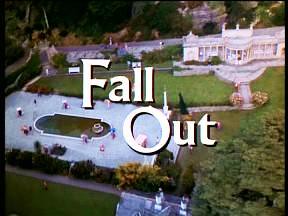
Fall Out starts differently - a three minute recap of "Once Upon A Time" followed by a plain title card - but very quickly, goes nowhere. Admittedly conceived in a rush, it throws away any attempt at a straightforward narrative to move towards a more allegorical ending, and although its open-endedness allows for some debate, it doesn't quite seem to fit. In short, it's like a high school term paper cribbed from Wikipedia articles.
There are some excellent touches, and some really intelligent twists that, given further development, might have ended The Prisoner on an even stronger note. Although many have cited the use of the Beatles' "All You Need Is Love", the episode's use of key lines make it almost ironic - McGoohan daring us to fight even the prevailing social movement at the time. McKern's Number 2 also has some key lines, including the very telling "New allegiances...such is the price of fame...and failure." In short, the episode seems to suggest that Number 2, in his own way, was like Number 6, except he "resisted for so short a time" and failed to relinquish his number. (Plus, there's a very clever in-joke at the end of Fall Out)
The rest of the episode, however, falls extremely short. Number 6's "trial" seems more like an attempt to inject a sense of surrealism, the insertion of the song "Dry Bones" a heavy handed effort to insert religious imagery...and the final 20 minutes seem to come from out of nowhere. The last-minute nature of the writing and directing of the episode shows, and it's a frustrating view not because it doesn't directly answer questions...but because there's little internal logic to it. (To be honest, the hint of the cyclical nature of Number 6's struggle is a well-deserved stroke of genius, reminding the viewer that the struggle for freedom never truly ends). Although the episode initially sets up a typical James Bond-ian moment to meet "Number One", the viewer senses that this is all an extreme, well-planned, staged psychodrama...
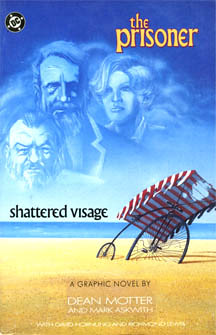 ....which is the assumption that 1988's graphic novel, The Prisoner: Shattered Visage (non-affiliate link) takes in its narrative. Although many fan sites like the Unmutual seem to disregard it (and I suggest checking out the Unmutual page, as well as the Anorak Zone Guide to the Prisoner, as two excellent Prisoner sites), the novel acts as more of a bookend than a full-blooded sequel. (In fact, both Steve Englehart and Jack Kirby had attempted to adapt the series in comic book form, with admittedly mixed results) However, it provides not only a great analysis, but even creates some further questions.
Thomas Drake (who is a slight nod to the show's Danger Man roots, but also a link to Sir Francis...and possibly this little-known historical figure) has helped the McKern Number 2 write a book entitled The Village Idiot. In addition, Thomas' slightly estranged wife Alice (yes, it's an obvious nod) decided to go on a world sailing expedition, but finds herself stranded on an unusual island...with a very familiar face...
Although Dean Motter's writing is superb - drawing disparate elements in a story that often feels like episodes 18 - 22 of the original series, Mark Askwith's art is...well, at times I found it unreadable, and needlessly abstract. Although it is an honest attempt to convey the shadowy, abstract world of the espionage field, it doesn't quite work at times, often looking garish and jarring. The story, though, better integrates some of the religious imagery that McGoohan was attempting (such as speaking of "Archangels" and "Gods"), reintroduces us to some old friends, and also reinforces the McKern-Number-2-as-failed-Number-6 archetype in one key sequence.
But the most clever part of Shattered Visage is how it integrates the sloppiness of Fall Out into its story, but makes it a key character moment for Number 6. By suggesting that Fall Out was staged so that Number 6 would, in effect, defy his own belief structure and take on a number, Motter suggests that no one really is fallible...and allows Number 6 to truly become a prisoner. In fact, his psychological disintegration - and the fact that Number 6 actually lost the war - makes Shattered Visage a good read for those who want to see a semi-satisfactory conclusion.
Towards the end, Number 6 makes a statement that, well, seems chilling in its implications - when asked who Number One is, he simply asks, "Does the presence of Number Two...require the existence of Number One?"
Just think about it...
But I'll end this entry with a close-to-the-end exchange, which answers nothing - and everything - at the same time:
"But what about your information...your secrets?"
"Safe"
"How can you be so certain?"
"None of us would be here if they weren't"
When I took on this effort several months ago, I never realized how tough it would be - most of the series is pitched at a high level, and requires a great attention to detail. The almost manic, paranoid tone can be a bit grating - if you are desiring to watch the series, my suggestion is watching it one or two episodes at a time, preferably over a series of weeks. Since it is available for free via Shout Factory TV and Tubi (with ads, but a good ad blocker can help), accessing the series is much easier than ever.
However, even though the attempts to revive The Prisoner seem to be faltering (and the current WGA strike may have further impact on its development), I believe that updating the series is not only important - but necessary. Some of the episodes (such as The General) are beginning to show their age, but more importantly - there is a need for a lone cry of rebellion, of asserting indivdiual freedom, and of challenging the forces that attempt to claim our spirits, especially in the wake of 9/11. Never more in our "everything-is-out-in-the-open" times do we need a voice telling us to reclaim our lives, and that the fight for privacy and personal integrity is more than just a good idea - it's what makes us human, and is independent of time frame.
Fall Out starts differently - a three minute recap of "Once Upon A Time" followed by a plain title card - but very quickly, goes nowhere. Admittedly conceived in a rush, it throws away any attempt at a straightforward narrative to move towards a more allegorical ending, and although its open-endedness allows for some debate, it doesn't quite seem to fit. In short, it's like a high school term paper cribbed from Wikipedia articles.
There are some excellent touches, and some really intelligent twists that, given further development, might have ended The Prisoner on an even stronger note. Although many have cited the use of the Beatles' "All You Need Is Love", the episode's use of key lines make it almost ironic - McGoohan daring us to fight even the prevailing social movement at the time. McKern's Number 2 also has some key lines, including the very telling "New allegiances...such is the price of fame...and failure." In short, the episode seems to suggest that Number 2, in his own way, was like Number 6, except he "resisted for so short a time" and failed to relinquish his number. (Plus, there's a very clever in-joke at the end of Fall Out)
The rest of the episode, however, falls extremely short. Number 6's "trial" seems more like an attempt to inject a sense of surrealism, the insertion of the song "Dry Bones" a heavy handed effort to insert religious imagery...and the final 20 minutes seem to come from out of nowhere. The last-minute nature of the writing and directing of the episode shows, and it's a frustrating view not because it doesn't directly answer questions...but because there's little internal logic to it. (To be honest, the hint of the cyclical nature of Number 6's struggle is a well-deserved stroke of genius, reminding the viewer that the struggle for freedom never truly ends). Although the episode initially sets up a typical James Bond-ian moment to meet "Number One", the viewer senses that this is all an extreme, well-planned, staged psychodrama...
....which is the assumption that 1988's graphic novel, The Prisoner: Shattered Visage (non-affiliate link) takes in its narrative. Although many fan sites like the Unmutual seem to disregard it (and I suggest checking out the Unmutual page, as well as the Anorak Zone Guide to the Prisoner, as two excellent Prisoner sites), the novel acts as more of a bookend than a full-blooded sequel. (In fact, both Steve Englehart and Jack Kirby had attempted to adapt the series in comic book form, with admittedly mixed results) However, it provides not only a great analysis, but even creates some further questions.Thomas Drake (who is a slight nod to the show's Danger Man roots, but also a link to Sir Francis...and possibly this little-known historical figure) has helped the McKern Number 2 write a book entitled The Village Idiot. In addition, Thomas' slightly estranged wife Alice (yes, it's an obvious nod) decided to go on a world sailing expedition, but finds herself stranded on an unusual island...with a very familiar face...
Although Dean Motter's writing is superb - drawing disparate elements in a story that often feels like episodes 18 - 22 of the original series, Mark Askwith's art is...well, at times I found it unreadable, and needlessly abstract. Although it is an honest attempt to convey the shadowy, abstract world of the espionage field, it doesn't quite work at times, often looking garish and jarring. The story, though, better integrates some of the religious imagery that McGoohan was attempting (such as speaking of "Archangels" and "Gods"), reintroduces us to some old friends, and also reinforces the McKern-Number-2-as-failed-Number-6 archetype in one key sequence.
But the most clever part of Shattered Visage is how it integrates the sloppiness of Fall Out into its story, but makes it a key character moment for Number 6. By suggesting that Fall Out was staged so that Number 6 would, in effect, defy his own belief structure and take on a number, Motter suggests that no one really is fallible...and allows Number 6 to truly become a prisoner. In fact, his psychological disintegration - and the fact that Number 6 actually lost the war - makes Shattered Visage a good read for those who want to see a semi-satisfactory conclusion.
Towards the end, Number 6 makes a statement that, well, seems chilling in its implications - when asked who Number One is, he simply asks, "Does the presence of Number Two...require the existence of Number One?"
Just think about it...
But I'll end this entry with a close-to-the-end exchange, which answers nothing - and everything - at the same time:
"But what about your information...your secrets?"
"Safe"
"How can you be so certain?"
"None of us would be here if they weren't"
When I took on this effort several months ago, I never realized how tough it would be - most of the series is pitched at a high level, and requires a great attention to detail. The almost manic, paranoid tone can be a bit grating - if you are desiring to watch the series, my suggestion is watching it one or two episodes at a time, preferably over a series of weeks. Since it is available for free via Shout Factory TV and Tubi (with ads, but a good ad blocker can help), accessing the series is much easier than ever.
However, even though the attempts to revive The Prisoner seem to be faltering (and the current WGA strike may have further impact on its development), I believe that updating the series is not only important - but necessary. Some of the episodes (such as The General) are beginning to show their age, but more importantly - there is a need for a lone cry of rebellion, of asserting indivdiual freedom, and of challenging the forces that attempt to claim our spirits, especially in the wake of 9/11. Never more in our "everything-is-out-in-the-open" times do we need a voice telling us to reclaim our lives, and that the fight for privacy and personal integrity is more than just a good idea - it's what makes us human, and is independent of time frame.
(Edit - AMC did revive the series for six episodes in 2009. Well, not so much "revived" as "reimagined" them. It wasn't very good. Big Finish also created a three-volume audio "reimagining" which I have not heard as of 2023)
Just to compare: in 1967, the United States was involved in an unpopular war. The geopolitical situation was unstable, and threatened to collapse at any moment. Environmental concerns were becoming more prevalent, and will soon lead to drastic change in policy if unchecked. Popular culture consists primarily of franchises, outlets into fantasy, and shows which reflected national unease at world events.
In 2007, the United States is involved in an unpopular war. The geopolitical situation is unstable, and threatens to collapse at any moment. Environmental concerns are becoming more prevalent, and will soon lead to drastic change in policy if unchecked. Popular culture provides franchises, outlets into fantasy, and shows which reflect national unease at world events.
Just to compare: in 1967, the United States was involved in an unpopular war. The geopolitical situation was unstable, and threatened to collapse at any moment. Environmental concerns were becoming more prevalent, and will soon lead to drastic change in policy if unchecked. Popular culture consists primarily of franchises, outlets into fantasy, and shows which reflected national unease at world events.
In 2007, the United States is involved in an unpopular war. The geopolitical situation is unstable, and threatens to collapse at any moment. Environmental concerns are becoming more prevalent, and will soon lead to drastic change in policy if unchecked. Popular culture provides franchises, outlets into fantasy, and shows which reflect national unease at world events.
Edit - In 2023, we're living through a time of absolute political and sociological chaos. Many of us have chosen to abandon reason and individuality for the sake of conspiracy theories and political tribalism. We shrug as the last vestigates of our privacy erode, willing to exchange our personal data for the sake of some algorithm feeding us "content" designed to drive compliance and consumerism rather than independent thought. In short, contemporary culture is Patrick McGoohan's worst nightmare and The Prisoner is more relevant than ever.
Six of one, half a dozen or the other.
Be seeing you.
Six of one, half a dozen or the other.
Be seeing you.
November 4, 2007
Sundays in the Village: Once Upon a Time

"I'm not an inmate....You can say what you like, you brought me back here. I told you last time, you were using the wrong approach. I do it my way, or you find somebody else."
(Revised 01/05/2023)
It's hard to write about this episode objectively, or to discuss the plot - not because of spoilers, but because this episode is well-directed, well-written, and well-acted. We see the return of Leo McKern's Number 2, perhaps still smarting from his last failed attempt to break Number 6. After checking out Number 6 in his "natural habitat" (asking repeatedly, "Why do you care?"), and watching a montage of early clips, Number 2 invokes "Degree Absolute" - basically, a psychological cage match. Two men go in, find the missing link, put it together...than bang! (Of course, Number 2 did not account for the amount of transference and countertransference that would happen...but that would be a spoiler, now, wouldn't it?)
But what's revelatory about this episode is how stripped down it is...and how effective it is in revealing much about the characters of Number 6 and McKern's Number 2. We learn that Number 2 considers himself flawed (as he himself stated, "I was a good man once) and reluctant to go back to his old Village ways. But we learn much more about Number 6 - his issues with his father (perhaps presaging his rebelliousness?), his unwillingness to kill (perhaps fulfilling this theory?), but most importantly, another rationale for his resignation ("Peace of mind....Too many people know too much...").
But ultimately, why do I feel this should have been the last episode? Ultimately, it took the themes of The Prisoner and distilled them into a battle between two men: the man who would not conform vs. the man who did and regretted it. In many ways, Number 2 and Number 6 are flip sides of the same coin. Plus, the way the episode ends leaves it open for multiple interpretations, and would have set up an interesting context to view the previous episodes. Although it still would have come up as insufficient in answering questions (Who is Number 1? Who runs the Village? Who is Number 6, and why did he resign?), it would have ended the series on an excellent note - it's an episode that's as perfect as a three minute pop single.
This episode should have been the finale.
Instead, we got Fall Out.
But more on that - and the graphic novel sequel - next week.
Be seeing you.
October 28, 2007
Sunday In the Village: The Girl Who Was Death
 (Revised 01/05/2023)
This episode, is....well, kind of an anomaly. It was intended to serve as a "distraction", a light-hearted foray before the more intense "Once Upon a Time" and "Fall Out." It's the first Prisoner episode that contains a semblance of humor - the first twenty minutes have a great, almost surrealistic quality. (It's also the first overtly "spy-ish" episode, even so far as to paraphrasing an episode title from its sister series The Avengers at a key moment.) Towards the end, it even takes on some slightly Pythonesque
 touches, from Number 6 dressing like Sherlock Holmes to the villain's Napoleon motif. At both ends, the episode contains some great, sly humor.
Unfortunately, the middle of the episode is disjointed and rather rushed. Since this had been (according to rumor) originally a two-part Danger Man episode, it has a rushed feel. (I am not suggesting that this would work as a two-parter; mostly, there could have been better choices in how edited material was handled. As it stands, at this point in the series' production, there was a mad dash towards the end. The fact that several key components - as well as one actor - were included in "Fall Out" says more about the 11th hour nature of ending the series than a deliberate setting-up of later plot elements).
Still, there are two things about this episode (framed as a children's bedtime story) that give it some importance (as well as providing some context). First, the plot of a woman who considers Number 6 her "opposite number"...well, remember last week's scenario? This - framed through Number 6's experience, of course - may explain a lot about his feelings towards women. Having someone simultaneously "love" you - and want to kill you - might have been one of the key issues that led Number 6 to resign.
Secondly, we see that there are children in the Village, which has both chilling and hopeful connotations. Chilling, because they may be the result of parents who chose to stay in the Village, who gave up their innermost secrets - in short, these children are paying for the sins of their fathers and mothers. Truly, they are innocents in the Village's plans.
However, there's something hopeful in Number 6 being their caretaker...perhaps he is, between episodes, encouraging them not to be pushed, filed, stamped, indexed, briefed, debriefed, or numbered...and that their lives are their own.
Coming soon: Degree Absolute. Number 6 on trial. Twenty years later.
Be seeing you.
at a key moment.) Towards the end, it even takes on some slightly Pythonesque touches, from Number 6 dressing like Sherlock Holmes to the villain's Napoleon motif. At both ends, the episode contains some great, sly humor.Unfortunately, the middle of the episode is disjointed and rather rushed. Since this had been (according to rumor) originally a two-part Danger Man
episode, it has a rushed feel. (I am not suggesting that this would work as a two-parter; mostly, there could have been better choices in how edited material was handled. As it stands, at this point in the series' production, there was a mad dash towards the end. The fact that several key components - as well as one actor - were included in "Fall Out" says more about the 11th hour nature of ending the series than a deliberate setting-up of later plot elements).Still, there are two things about this episode (framed as a children's bedtime story) that give it some importance (as well as providing some context). First, the plot of a woman who considers Number 6 her "opposite number"...well, remember last week's scenario? This - framed through Number 6's experience, of course - may explain a lot about his feelings towards women. Having someone simultaneously "love" you - and want to kill you - might have been one of the key issues that led Number 6 to resign.
Secondly, we see that there are children in the Village, which has both chilling and hopeful connotations. Chilling, because they may be the result of parents who chose to stay in the Village, who gave up their innermost secrets - in short, these children are paying for the sins of their fathers and mothers. Truly, they are innocents in the Village's plans.
However, there's something hopeful in Number 6 being their caretaker...perhaps he is, between episodes, encouraging them not to be pushed, filed, stamped, indexed, briefed, debriefed, or numbered...and that their lives are their own.
Coming soon: Degree Absolute. Number 6 on trial. Twenty years later.
Be seeing you.
October 21, 2007
Sundays in the Village: Forsaking Harmony
(Revised 01/04/2023)
"Do Not Forsake Me O My Darling" is...a mess. It isn't even a redeemable mess or even a Get Smart-Esque satire. Filmed while McGoohan was off working on Howard Hughes' favorite movie, the script could be more varied and cliche, and the acting could be better. It provides little - if any - information about Number 6 or the Village. It's about a step away from being openly mocked by Bill, Kevin, and Mike. Your life won't be changed if you never catch this episode. Definitely worth avoiding.
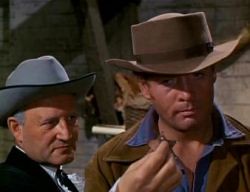
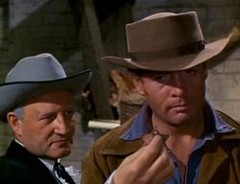
However, "Living in Harmony" - allegedly not shown in its original run in 1968 for various reasons (including a strong anti-Vietnam message and concerns about onscreen violence and drug use) - is not only an effective episode but serves to provide some really interesting grist for the mill. In this episode, the Prisoner is recast as a Western, with Number 6 attempting to "leave" as sheriff, only to find himself in the town of Harmony. Like in many episodes of The Prisoner
 , Number 6 (or "The Man With No Name") finds himself in situations similar to a usual Prisoner episode - fighting for a troubled young lady, as well as meeting up with a young, not-quite-there gunfighter...until we learn that it has all been a massive role-play - the 1960's equivalent of "virtual reality."
However, "Living in Harmony" contains a key piece of insight - something which tends to get overlooked, but I think is a great possible "theory" behind Number 6's resignation.
At one point in Harmony, Number 6 tells "the Mayor" that he will take "the badge, not the gun" - we see Number 6 relinquish firearms at the beginning of the episode, and throughout, he relies more on bare fist fighting for self-defense. However, at a later point in the episode, Number 6 takes a gun...and turns in his badge. (It's actually one of two instances we see Number 6 pick up a weapon - the second will be in "Fall Out"). Granted, Number 6 is drugged and being fed information, but given that even under the best of circumstances, there are still opportunities for Freudian slips - for Number 6 to reveal information subconsciously.
What do we know from previous episodes? Number 6 was a good worker who rarely, if ever, questioned orders. He distrusts women but repeatedly runs to the rescue of "damaged" women. "Many Happy Returns" shows Number 6's open disdain for gun runners. He has cited that his resignation is a "matter of conscience" and that he needed "time to think."
Scenario - Number 6 is placed on an assignment that involves the deliberate taking of human life, an assignment that goes against his moral code. During this assignment, he works with/is under the influence of a woman - a woman who initially demonstrates a weakness and/or "needs to be rescued" but who ultimately ends up betraying him. (Think "Big Ben" or "Schizoid Man"). During this assignment, Number 6 is forced - for survival reasons - to shoot and kill this particular woman. As a result, he realizes that his job will force him to make difficult choices - and by taking a deliberate life, he needs time to consider what he has done and how he wishes to conduct himself in the espionage world. In short, how does a moral man "live in harmony" with an amoral environment?
This scenario accounts for many aspects presented in the series yet still leaves the question of "what information does Number 6 possess?" open for speculation. It helps us understand why Number 6 relies on his brains/fists frequently (a more personal way of contact and does not bring up a very painful situation). This scenario also allows Number 6 to simultaneously distrust women (especially the four-legged variety) and yet act out of some chivalrous code in other situations. (It also explains why his relationship with his "fiance," Janet, seems rather distant in "Do Not Forsake Me...") Finally, we understand why Number 6 refuses to cooperate with the Village - he is very much like Rorschach in Watchmen, a man unwilling to bend to make life easier and refuses to compromise his principles.
Even in the face of Armageddon.
Which, in series terms, is about three episodes away.
Coming soon: A charming distraction. The episode that should have ended Prisoner. The one that did. And the graphic novel sequel.
October 14, 2007
Sundays In the Village: Hammer Into Anvil
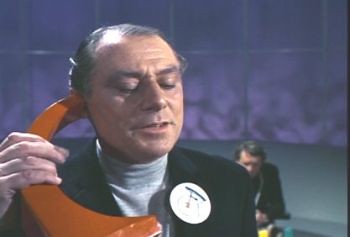 Number 2: "You shouldn't have interfered. Number 6....you will pay for this"
Number 6: "No....you will"
(Revised 01/04/2023)
"Hammer Into Anvil" is just an intellectual bare-knuckle brawl, with Number 6 doing his best to tear down Number 2. Even though the DVD case
indicates that Number 2 is not the same character as Thorpe from "Many Happy Returns"...the performances by Patrick Cargill suggest otherwise. (Plus, it gives some rationale as to why Number 6 is taking this so personally). Other reviews have called Cargill's performance hammy, but that's kind of the point - this is a professional sadist who reveals his hidden paranoia as his authority is threatened by a "conspiracy." After intercepting a note to "XO4" from "D6", Number 2 is convinced that Number 6 is a "plant,"...and Number 6 does nothing to change that perception.If the Internet existed thirty years earlier, this episode might be accused of plagiarising "that old Angela Lansbury movie
 ." However, it's a little more than that - it's a study of power and control. We see that, in the Village, people who die deep their number but lose their name. We see Number 6 engage in seemingly random behavior towards a malevolent end. In short, it's the kind of episode where the outcome is predictable, but getting there send chills down the viewer's spine.
"You must be hammer or anvil"One of the more intriguing aspects of this episode is its blatant intellectualism - of all of The Prisoner episodes, this is the one that easily wears its literacy on its sleeve. For example, we hear quotes from Cervantes and Goethe (whose quote, according to Wikipedia, is misinterpreted) tossed as casually as pop culture references in contemporary conversation. Reflecting its science fiction basis, it is one of the first uses of voice print identification in popular drama. However, the use of music is key - many times, we see signs in the Village - Music begins where words lead off, Music makes a quiet mind - and several classical pieces are key to the plot. But in one key fight sequence, slow and thoughtful music is used to counterbalance a violent fight.
(One major quibble about The Prisoner is a shocking double standard - showing pleasant/romantic relationships between women and men is forbidden, but violence is OK. This subject has been touched on before - McGoohan was supposed to be a moral, very devout Catholic and wanted The Prisoner to be family-friendly. However, most of the women in the Village are either co-conspirators (remember, Number 6 stated that one should never trust women, especially the four-legged variety) or emotionally unstable. Yet, it is perfectly permissible to show two men in violent fighting and fisticuffs. Given that this happened at burgeoning movements examining violence on television and feminism, it seems rather....odd).
In the end, we see Number 2 and Number 6 in a confrontation, which is more a war of words than an all-out battle. Number 6 continues to berate the broken-spirited Number 2, mocking him by stating, "All this power at your disposal, and yet....you're alone." Further insults abound from Number 6, claiming Number 2 is "a blunderer who's lost his head...you've destroyed yourself..." The final insult - Number 2 is forced to report himself to his superiors (whom we know he fears most), and Number 6 walks off, leading to a very disturbing thought:
Number 6 would make an excellent Number 2
Coming soon: Howard Hughes' favorite episode? Cowboys and Villagers. And Number 6 versus Napoleon.
Be seeing you.
October 7, 2007
Sundays in the Village: A Change of Mind
 "We deplore your spirit of disharmony"
Number 6: "That's...a common complaint around here, isn't it?
(Revised 01/04/2023)
I was going to review "A Change of Mind" along with "Hammer Into Anvil", but two things prevented me. One is that "Hammer Into Anvil" is an extremely intense episode that deserves its own column. However, recent events involving a presidential candidate and his unwillingness to "demonstrate his patriotism" make our present entry timely. Well, that and the Chicago Public Library's One Book, One Chicago selection.
"A Change of Mind" is The Prisoner demonstrating its strength in Orwellian allegory. The allegory is razor-sharp and serves as a timeless critique of movements ranging from the Red Scare to political correctness. It's also one of my favorite episodes, but for a different reason - I attended a for-profit graduate school in psychology for one year. While there, I encountered several dangerous tendencies towards groupthink, including being forced to leave due to an individual deciding to "leak" information from a confidential group therapy class, thereby painting me in a negative light. Luckily, after a year off, I attended a real graduate school...but enough of my ranting - onto the episode.
What furthers this is Number 2, who serves as the kindly, Big Brother-Esque leader of the situation. Much like Lou Ford in Jim Thompson's The Killer Inside Me , this Number 2 decides to "kill with kindness," using banal phrases in an attempt to wear down his opposition. Since Number 6 will not overtly cooperate, Number 2 enlists the help of Number 86 (who is an attractive blonde and not Maxwell Smart) to insure Number 6's cooperation, eventually leading to a high-tech lobotomy to reduce Number 6's resistance.
Or does it?
As the lobotomy sequence proceeds, we see that on some level, The Prisoner reflects much of the "mental-illness-as-unconventional-thinking" philosophy of Thomas Szasz. However, it is soon revealed that the goal is to keep Number 6 drugged through Mytol (which, believe it or not, is a real drug), and Number 2 attempts to utilize the situation to gain the holy grail: the reason behind Number 6's resignation. We're given a tantalizing clue - Number 6 mutters, "Time to think" - but soon, Number 6 turns the tables on Number 2 and uses the Village groupthink against its initiator.
Admittedly, this is one of the episodes directed by Patrick McGoohan, and it's well-paced...except for the ending. Production around this time was hectic, with McGoohan and script editor George Markstein clashing over the direction (Markstein wanting a more conventional espionage thriller, McGoohan wishing a more allegorical direction). There are several episodes of The Prisoner that deal with the psychology of power and control between individuals. This week's episode handles group dynamics...but what about psychological dominance?
(EDIT - Looking at this episode from a 2023 perspective, it would be easy to see it as a cautionary tale against "political correctness" or "wokeness." However, it could also be seen as an allegory for those who engage in such behavior. After all, what is "unmutual" except another way of saying 'expressing values that bother the majority'?" Food for thought.)
"A Change of Mind" is The Prisoner
demonstrating its strength in Orwellian allegory. The allegory is razor-sharp and serves as a timeless critique of movements ranging from the Red Scare to political correctness. It's also one of my favorite episodes, but for a different reason - I attended a for-profit graduate school in psychology for one year. While there, I encountered several dangerous tendencies towards groupthink, including being forced to leave due to an individual deciding to "leak" information from a confidential group therapy class, thereby painting me in a negative light. Luckily, after a year off, I attended a real graduate school...but enough of my ranting - onto the episode.Number 2: There is a saying: "The slowest mule is nearest to the whip"The story begins with Villagers taunting Number 6, proclaiming that his behavior is "not (that) of a citizen" and that he will be brought before the "committee" for their unique "social work." It is this episode that sharply analyzes how group behavior can slowly but surely, degenerate into mass hysteria. Most of the Villagers' dialog consists mainly of buzzwords: "Disharmony." "Believe me," "Reactionary! Rebel! Disharmonious!" All this helps whip the Village against Number 6, who is determined to be "unmutual", which is "doubleplusungood" for Number 6.
Number 6: Yes, and another: "He who digs a pit will one day lie in it"
What furthers this is Number 2, who serves as the kindly, Big Brother-Esque leader of the situation. Much like Lou Ford in Jim Thompson's The Killer Inside Me
, this Number 2 decides to "kill with kindness," using banal phrases in an attempt to wear down his opposition. Since Number 6 will not overtly cooperate, Number 2 enlists the help of Number 86 (who is an attractive blonde and not Maxwell Smart) to insure Number 6's cooperation, eventually leading to a high-tech lobotomy to reduce Number 6's resistance.Or does it?
As the lobotomy sequence proceeds, we see that on some level, The Prisoner reflects much of the "mental-illness-as-unconventional-thinking" philosophy of Thomas Szasz. However, it is soon revealed that the goal is to keep Number 6 drugged through Mytol (which, believe it or not, is a real drug), and Number 2 attempts to utilize the situation to gain the holy grail: the reason behind Number 6's resignation. We're given a tantalizing clue - Number 6 mutters, "Time to think" - but soon, Number 6 turns the tables on Number 2 and uses the Village groupthink against its initiator.
Admittedly, this is one of the episodes directed by Patrick McGoohan, and it's well-paced...except for the ending. Production around this time was hectic, with McGoohan and script editor George Markstein clashing over the direction (Markstein wanting a more conventional espionage thriller, McGoohan wishing a more allegorical direction). There are several episodes of The Prisoner that deal with the psychology of power and control between individuals. This week's episode handles group dynamics...but what about psychological dominance?
(EDIT - Looking at this episode from a 2023 perspective, it would be easy to see it as a cautionary tale against "political correctness" or "wokeness." However, it could also be seen as an allegory for those who engage in such behavior. After all, what is "unmutual" except another way of saying 'expressing values that bother the majority'?" Food for thought.)
Coming soon:
What if...the roles were reversed, and Number 6 "tested" Number 2?
What if...Number 6 was played by another actor?
What if...The Prisoner took place in the American West in the late 19th Century?
Be Seeing You.
September 30, 2007
Sundays in the Village: It's Your Funeral

Preventing is only postponing
(Revised 01/04/2023)
Watching The Prisoner in a post 9/11 world is... interesting, to say the least - its themes of individualism vs. collectivism seem at odds with current societal trends. Cameras scrutinizing our every move, once a great evil, are now a staple of reality television. Episodes that seemed cutting edge in the late 1960s, like The General, seem almost curiously outdated. But like many works of art, The Prisoner develops different facets with the onset of years.
As a result, episodes that might have seemed almost preachy in then-contemporaneous times take on a ripped-from-the-headlines nature in the dawning years of the 21st century. "It's Your Funeral," which may have seemed almost prescient in terms of the assassinations of Martin Luther King and Robert Kennedy, now takes on greater dimensions...especially since, pre-9/11, our president once remarked that there was "too much freedom." From page to stage, this is easily one of the most relevant - and allegorical - episodes in our times.
As a result, episodes that might have seemed almost preachy in then-contemporaneous times take on a ripped-from-the-headlines nature in the dawning years of the 21st century. "It's Your Funeral," which may have seemed almost prescient in terms of the assassinations of Martin Luther King and Robert Kennedy, now takes on greater dimensions...especially since, pre-9/11, our president once remarked that there was "too much freedom." From page to stage, this is easily one of the most relevant - and allegorical - episodes in our times.
(EDIT - I may write a later essay for my Patreon page on how this episode - along with Free for All - fit in a post-January 6th landscape)
The episode begins with a woman finding her way into Number 6's apartment, and immediately, he suspects a trap. As she relates her tale - her father planning the assassination of a young Number 2 - Number 6 assures her that he'll "listen...as long as what (she) say(s) isn't too obviously phony." In an interesting montage, we see the Young Number 2 listen to a computer-recited itinerary, revealing Number 6's daily agenda. (Which mostly consists of clips from other episodes, in a nice cost-cutting measure). However, we learn that the Young Number 2 is involved with "Plan Division Q", a strategy advised by the pink-jacketed Number 1-0-0 (Not one hundred, but "one-zero-zero"). As Number 6 confronts the Young Number 2 with the plot, we learn about "Jammers", troublemakers who make plans...but who are relatively ineffectual, play pranks, and then ignored. As Number 6 leaves, Number 2 calls his assistant, Number 22 (or "Number 2's number 2) with a plan to discredit Number 6...and take care of a nagging detail....
However, when we next encounter Number 6, he meets with another Number 2 - an older gentleman who seems to share a mutual respect with Number 6. The elder Number 2 shows Number 6 a series of films basically discrediting his "assassination plot," revealing a possible motive - the elimination of the Elder Number 2. (Given that both men seem to have a healthy respect - and with rumors that the series had been conceived of two 13-episode "seasons" - perhaps this elder Number 2 did not consider the rationale behind Number 6's resignation important...hence, the need to eliminate the Elder Number 2).
This is an episode that is hard to explain in summary, mostly because it hits on many themes - we begin to learn that Number 6 has an aversion for innocents being harmed and a distaste for lethal violence. (More on this later...) With its examination of the use of violence in politics, this takes a much stronger stance on the subject than the later "Fall Out". It's move-and-countermove plotting is reminiscent of Checkmate without being derivative, and a slowly creeping paranoia builds throughout the episode. (Chris Carter must have analyzed this episode frame-by-frame) And the greatest call-out of a traitor, the Elder Number 2 stating to this person that "The fact that you won't explain...explains everything," is possibly the best one-line summary of the show ever written.
For the longest time, this was one of my ok-but-not-quite-great episodes. Now, in these troubled times, it looks much more like the masterpiece that it is.
Coming soon: Number 6 quotes Goethe. On being unmutual. Number 6 escapes the Village....and the infamous "lost" episode.
Be seeing you.
The episode begins with a woman finding her way into Number 6's apartment, and immediately, he suspects a trap. As she relates her tale - her father planning the assassination of a young Number 2 - Number 6 assures her that he'll "listen...as long as what (she) say(s) isn't too obviously phony." In an interesting montage, we see the Young Number 2 listen to a computer-recited itinerary, revealing Number 6's daily agenda. (Which mostly consists of clips from other episodes, in a nice cost-cutting measure). However, we learn that the Young Number 2 is involved with "Plan Division Q", a strategy advised by the pink-jacketed Number 1-0-0 (Not one hundred, but "one-zero-zero"). As Number 6 confronts the Young Number 2 with the plot, we learn about "Jammers", troublemakers who make plans...but who are relatively ineffectual, play pranks, and then ignored. As Number 6 leaves, Number 2 calls his assistant, Number 22 (or "Number 2's number 2) with a plan to discredit Number 6...and take care of a nagging detail....
Older Number 2: "I can think of better ways to die"In the midst of the episode, we are introduced to the sport of kosho - the major pastime of the Village, which involves trampolines, a wading pool, orange jumpsuits, and motorcycle helmets. An unusual martial art seems like the kind of game that two well-known comics bloggers would invent...and more of a diversion.
Number 6: "...and better causes...to die for"
However, when we next encounter Number 6, he meets with another Number 2 - an older gentleman who seems to share a mutual respect with Number 6. The elder Number 2 shows Number 6 a series of films basically discrediting his "assassination plot," revealing a possible motive - the elimination of the Elder Number 2. (Given that both men seem to have a healthy respect - and with rumors that the series had been conceived of two 13-episode "seasons" - perhaps this elder Number 2 did not consider the rationale behind Number 6's resignation important...hence, the need to eliminate the Elder Number 2).
This is an episode that is hard to explain in summary, mostly because it hits on many themes - we begin to learn that Number 6 has an aversion for innocents being harmed and a distaste for lethal violence. (More on this later...) With its examination of the use of violence in politics, this takes a much stronger stance on the subject than the later "Fall Out". It's move-and-countermove plotting is reminiscent of Checkmate without being derivative, and a slowly creeping paranoia builds throughout the episode. (Chris Carter must have analyzed this episode frame-by-frame) And the greatest call-out of a traitor, the Elder Number 2 stating to this person that "The fact that you won't explain...explains everything," is possibly the best one-line summary of the show ever written.
For the longest time, this was one of my ok-but-not-quite-great episodes. Now, in these troubled times, it looks much more like the masterpiece that it is.
Coming soon: Number 6 quotes Goethe. On being unmutual. Number 6 escapes the Village....and the infamous "lost" episode.
Be seeing you.
September 23, 2007
Sundays in the Village: Many Happy Returns
 (Revised 01/04/2023)
 This is a hard blog post to write.
The episode is okay - any episode whose first half is primarily silent with top-notch direction(except for four words in German) can't be faulted. Unfortunately, it's an episode that spoils itself through its title. It's also an episode that, plot-wise, never really goes anywhere. Number 6 finds the Village empty, decides to escape, makes his way by raft to London, meets his superiors (and in a nice twist, encounters the guy he resigned to, complete with theme music), and then....finds himself back in the Village.
Only your typical Gilligan's Island episode could be more predictable.
There are a few good moments - in the middle of the episode when Number 6 arrives at (presumably) the White Cliffs of Dover (if you're across the pond, please let me know if I'm right)...as he meets some Romany....and then makes his way to the heart of London, there seems to be the suggestion that he is "out of place", a prisoner without a prison.
The other - Mrs. Butterworth (no, not the former syrup lady, so don't even go there) is a slightly interesting character. Her appearance was "predicted" in a previous story. Although she's an OK Number 2...she's no Mary Morris. We also meet several of Number 6's colleagues, like the Colonel and Thorpe, who may or may not be Number 2 in a future story. I think he is the "Hammer into Anvil" Number 2 - in the espionage world, there may be less than six degrees of separation, and Patrick Cargill's performance here seems to mirror that later role).
However, if you had to choose a handful of episodes to miss, "Many Happy Returns" would be a candidate. It's not a bad episode of The Prisoner - just a so-so one.
Coming soon: Number 6 stops a plot, engages in another plot, and changes his mind figuratively...and literally.
Be seeing you.
The episode is okay - any episode whose first half is primarily silent with top-notch direction(except for four words in German) can't be faulted. Unfortunately, it's an episode that spoils itself through its title. It's also an episode that, plot-wise, never really goes anywhere. Number 6 finds the Village empty, decides to escape, makes his way by raft to London, meets his superiors (and in a nice twist, encounters the guy he resigned to, complete with theme music), and then....finds himself back in the Village.
Only your typical Gilligan's Island episode could be more predictable.
There are a few good moments - in the middle of the episode when Number 6 arrives at (presumably) the White Cliffs of Dover (if you're across the pond, please let me know if I'm right)...as he meets some Romany....and then makes his way to the heart of London, there seems to be the suggestion that he is "out of place", a prisoner without a prison.
The other - Mrs. Butterworth (no, not the former syrup lady, so don't even go there) is a slightly interesting character. Her appearance was "predicted" in a previous story. Although she's an OK Number 2...she's no Mary Morris. We also meet several of Number 6's colleagues, like the Colonel and Thorpe, who may or may not be Number 2 in a future story. I think he is the "Hammer into Anvil" Number 2 - in the espionage world, there may be less than six degrees of separation, and Patrick Cargill's performance here seems to mirror that later role).
However, if you had to choose a handful of episodes to miss, "Many Happy Returns" would be a candidate. It's not a bad episode of The Prisoner - just a so-so one.
Coming soon: Number 6 stops a plot, engages in another plot, and changes his mind figuratively...and literally.
Be seeing you.
September 16, 2007
Sundays in the Village: The Schizoid Man
 (Revised 01/04/2023)
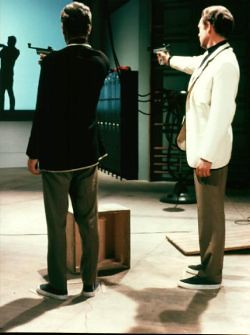
When last we saw Number 6, he had successfully destroyed a major indoctrination project in the Village. He has repeatedly thwarted the attempts of Number 2 to learn about his resignation. In "The Schizoid Man," the new Number 2 arrives at a very devious, extremely malicious plan - turn Number 6 into a co-conspirator (through drugs, operant conditioning, and other means) and basically break him down through an extended mind game. Or, to quote the episode directly:
"Your job, Number 12, will be to impersonate him (Number 6). Take his sense of reality away. Once he begins to doubt his own identity, he'll crack"This is one of those episodes of The Prisoner that is something of a mixed bag. If you gave the story a letter grade, it would be a B+, but only because of the last 15 minutes...and ironically, even though it misuses the word "schizoid" in 1960's terms, Number 6 seems to fit the DSM-4 criteria.
(EDIT - looking at the 2023 DSM-5 criteria...possibly still relevant)
The episode crackles along, with Number 6 and Number 12 (or "Number 6 version 2) playing an unusual game of psychological oneupmanship. The symbolism is sharp (both in terms of who wears which color jacket, as well as Alison or Number 24, "divided" by Numbers 2, 6, and 12), the dialogue crackles (Number 6's insults of Number 12 being from "the people's copying service" and "the economy pack"), and the irony of Number 12 "asserting" that he is Number 6 is subtle. The overall goal seems to begin with "Getting the information from Number 6" (on an "I know something you don't know" basis). Still, as Number 2 so malevolently points out, "By the time we're finished...he won't know whether he's Number 6 or the cube root of infinity". In these terms, the episode is a great example of psychological manipulation.
However, a few things about this episode ring slightly false.
First, this episode uses ESP as a plot point, and I have a slight bias against the use of ESP. Often, it is used as a "magical" device, and given The Prisoner's bias towards realistic science, it is slightly misused here. (There is an alleged "mental link" between Number 6 and Allison; however, given that the dialogue indicates a 68 - 74% success rate in mind reading, all it suggests is that Number 6 should never play poker with Allison). I can believe in the fantastic, whether it is a time-traveling alien in a box bigger on the inside than on the outside or that a ship can surpass the speed of light; I cannot believe that telepathy is given "serious" treatment in this episode.
In addition, the last fifteen minutes are rushed, with various plot points being hammered home in a variety of cliches. (And there's no first-time-for-this-cliche either). It could have used another run through the typewriter; the fact that it leads to a "failed escape attempt" on Number 6's part just seems rushed.
Finally - and this is more of a general complaint - we see a Haitian and (presumably) a Sikh. That's not the complaint - other than those individuals and a female Asian in "Arrival", the Village seems totally non-diverse in terms of its population. Granted, comparing a 1960s show (created by a man born in the 1920s) to 21st-century standards is unfair. Just to put in perspective: at that time, there was a pioneering African-American male in the lead of an espionage drama, a leading co-star in the major hit of the day (which also featured an Asian guest star in its first season), two shows featuring a mixed cast, including a show focusing on young people and one which featured a paraplegic detective.
All of those were "formula" shows, yet demonstrated some movement towards diversity. It's a shame that The Prisoner - focusing on the fear of "one world" - never approached that. Or was it deliberate?
Who knows: after all, “Questions are a burden to others; answers a prison for oneself.”
Coming soon to Sundays in the Village:
“I know every nut and bolt and cog--I built it with my own hands!”
“I understand. The fact that you won't explain . . . explains everything.”
“To borrow one of Number Two's sayings: `The butcher with the sharpest knife . . . has the warmest heart.' ”
"A weak link in the chain of command. Waiting to be broken"
Be seeing you.
The episode crackles along, with Number 6 and Number 12 (or "Number 6 version 2) playing an unusual game of psychological oneupmanship. The symbolism is sharp (both in terms of who wears which color jacket, as well as Alison or Number 24, "divided" by Numbers 2, 6, and 12), the dialogue crackles (Number 6's insults of Number 12 being from "the people's copying service" and "the economy pack"), and the irony of Number 12 "asserting" that he is Number 6 is subtle. The overall goal seems to begin with "Getting the information from Number 6" (on an "I know something you don't know" basis). Still, as Number 2 so malevolently points out, "By the time we're finished...he won't know whether he's Number 6 or the cube root of infinity". In these terms, the episode is a great example of psychological manipulation.
However, a few things about this episode ring slightly false.
First, this episode uses ESP as a plot point, and I have a slight bias against the use of ESP. Often, it is used as a "magical" device, and given The Prisoner's bias towards realistic science, it is slightly misused here. (There is an alleged "mental link" between Number 6 and Allison; however, given that the dialogue indicates a 68 - 74% success rate in mind reading, all it suggests is that Number 6 should never play poker with Allison). I can believe in the fantastic, whether it is a time-traveling alien in a box bigger on the inside than on the outside or that a ship can surpass the speed of light; I cannot believe that telepathy is given "serious" treatment in this episode.
In addition, the last fifteen minutes are rushed, with various plot points being hammered home in a variety of cliches. (And there's no first-time-for-this-cliche either). It could have used another run through the typewriter; the fact that it leads to a "failed escape attempt" on Number 6's part just seems rushed.
Finally - and this is more of a general complaint - we see a Haitian and (presumably) a Sikh. That's not the complaint - other than those individuals and a female Asian in "Arrival", the Village seems totally non-diverse in terms of its population. Granted, comparing a 1960s show (created by a man born in the 1920s) to 21st-century standards is unfair. Just to put in perspective: at that time, there was a pioneering African-American male in the lead of an espionage drama, a leading co-star in the major hit of the day (which also featured an Asian guest star in its first season), two shows featuring a mixed cast, including a show focusing on young people and one which featured a paraplegic detective.
All of those were "formula" shows, yet demonstrated some movement towards diversity. It's a shame that The Prisoner
- focusing on the fear of "one world" - never approached that. Or was it deliberate?Who knows: after all, “Questions are a burden to others; answers a prison for oneself.”
Coming soon to Sundays in the Village:
“I know every nut and bolt and cog--I built it with my own hands!”
“I understand. The fact that you won't explain . . . explains everything.”
“To borrow one of Number Two's sayings: `The butcher with the sharpest knife . . . has the warmest heart.' ”
"A weak link in the chain of command. Waiting to be broken"
Be seeing you.
September 9, 2007
Sundays in the Village: AB&C and The General
"We all make mistakes...sometimes we have to"
(Revised 01/04/2023)
Look at any information on Colin Gordon, and you'll find that he was a standard, hard-working British actor - in fact, his dual stint as Number 2 on The Prisoner is his major claim to fame. However, his Number 2 is very distinct for several reasons, most notably that his is the closest that comes to figuring out the "why" of Number 6's resignation.
What do we know about this Number 2? He's arrogant towards Number 6 (in the "A, B, & C" pre-episode sequence, boldly announces that "I am Number 2" rather than "I am the new Number 2". However, he is slightly afraid of his superiors - often drinking milk (which he claims is "the perfect food") and looking pensively at the red question-mark-shaped phone on his desk. However, both "A, B & C" and "The General" show that this particular Number 2 is a foreshadowing of one of the major themes of The Prisoner - the use (or misuse) of science and technology.
I had forgotten how fiendishly clever "A, B & C" was as an episode until I watched it again; both foreshadowing character appearances (yes, I know several actors played multiple roles - I like to create my own inner continuity), episodes (such as Number 6 stating "No change of mind," where a later episode will be titled "A Change of Mind"), and contains some sharp directing (notice the A & B sequences, which are straightforward, then the more dreamlike C sequence). Plus, this is the first time a Number 2 has a theory about Number 6's resignation (that the latter was about to "sell out"), rather than a straightforward I-will-break-Number-6 plot. This use of the scientific method suggests that Number 2 is more scientist than spy (and both of these episodes are more science-fiction in tone)
In "A, B & C", we get some very subtle clues about Number 6's pre-Village life. He is a rather restrained yet flirtatious guest who knows people on both sides of the Cold War. By his own admission, he has "never liked secrets", and Number 14 (the female doctor) notices an "anguish pattern" around his resignation. Number 6 has some travel brochures with him and simply states that he plans to go on a post-resignation trip to "Somewhere different, somewhere quiet, somewhere I can think". Given the character assessment in Arrival, I think this is probably the best "theory" as to why Number 6 left his job - he was overworked and needed a break.
But obviously, despite Number 2's "failure" in this regard, he has a much larger - and more important - project to oversee. A project called "Speedlearn". It's stated goal: 100% entry, 100% pass.
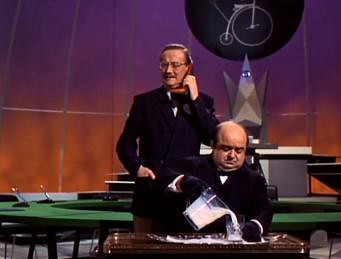
"Probably the most important human experiment we've ever had to conduct, and it's treated like a military exercise"
"The General", unfortunately, is not an episode that holds up well upon repeated watching. Many of the themes prevalent - mass indoctrination through media, and lack of critical thinking - are eerily prescient of current times. In addition, we see one symbol - the pallbearer from the beginning credits - explained: it's the "uniform" of the Village equivalent of "civic leaders." It's an episode that, for once, does not focus on Number 6's head - it reveals a slight shift in emphasis. Now, Number 6 makes it his business to destroy the Village internally.
This episode, however, is extremely heavy-handed in handling its theme, its symbolism (Number 12 being "divided" by Number 2 and Number 6?), its attempt at satire, and in drama. In short, it reads like a Rod Serling Twilight Zone pastiche. If they had the budget, Serling could have easily given this a polish between drafts of Planet of the Apes. As it stands, "The General" is not a bad episode per se - it helps us shift towards a broader view of the struggle between Number 6 and the Village. Number 2, as science, sees a device that would have brought about massive influence and achievement of the Village's goals destroyed, even though he sees it as more of a "human experiment". (The fact that the Village sees Speedlearn as "a military exercise reveals much about the malevolence of the powers that be, whether it's "Us", "Them", or "None of the above")
However, the end result is the same - Number 6 has not just defied the Village but has now hurt them. He cannot be ostracized, manipulated, corrupted, or fooled into complying.
From now on, it's no longer a game.
The rules no longer apply.
It's a war between the Village and Number 6.
Coming soon: Number 6 believes in ESP. Number 6 builds a raft. And Number 6 stops a revolution - or does he?
Be seeing you.
What do we know about this Number 2? He's arrogant towards Number 6 (in the "A, B, & C" pre-episode sequence, boldly announces that "I am Number 2" rather than "I am the new Number 2". However, he is slightly afraid of his superiors - often drinking milk (which he claims is "the perfect food") and looking pensively at the red question-mark-shaped phone on his desk. However, both "A, B & C" and "The General" show that this particular Number 2 is a foreshadowing of one of the major themes of The Prisoner - the use (or misuse) of science and technology.
I had forgotten how fiendishly clever "A, B & C" was as an episode until I watched it again; both foreshadowing character appearances (yes, I know several actors played multiple roles - I like to create my own inner continuity), episodes (such as Number 6 stating "No change of mind," where a later episode will be titled "A Change of Mind"), and contains some sharp directing (notice the A & B sequences, which are straightforward, then the more dreamlike C sequence). Plus, this is the first time a Number 2 has a theory about Number 6's resignation (that the latter was about to "sell out"), rather than a straightforward I-will-break-Number-6 plot. This use of the scientific method suggests that Number 2 is more scientist than spy (and both of these episodes are more science-fiction in tone)
In "A, B & C", we get some very subtle clues about Number 6's pre-Village life. He is a rather restrained yet flirtatious guest who knows people on both sides of the Cold War. By his own admission, he has "never liked secrets", and Number 14 (the female doctor) notices an "anguish pattern" around his resignation. Number 6 has some travel brochures with him and simply states that he plans to go on a post-resignation trip to "Somewhere different, somewhere quiet, somewhere I can think". Given the character assessment in Arrival, I think this is probably the best "theory" as to why Number 6 left his job - he was overworked and needed a break.
But obviously, despite Number 2's "failure" in this regard, he has a much larger - and more important - project to oversee. A project called "Speedlearn". It's stated goal: 100% entry, 100% pass.
"Probably the most important human experiment we've ever had to conduct, and it's treated like a military exercise"
"The General", unfortunately, is not an episode that holds up well upon repeated watching. Many of the themes prevalent - mass indoctrination through media, and lack of critical thinking - are eerily prescient of current times. In addition, we see one symbol - the pallbearer from the beginning credits - explained: it's the "uniform" of the Village equivalent of "civic leaders." It's an episode that, for once, does not focus on Number 6's head - it reveals a slight shift in emphasis. Now, Number 6 makes it his business to destroy the Village internally.
This episode, however, is extremely heavy-handed in handling its theme, its symbolism (Number 12 being "divided" by Number 2 and Number 6?), its attempt at satire, and in drama. In short, it reads like a Rod Serling Twilight Zone pastiche. If they had the budget, Serling could have easily given this a polish between drafts of Planet of the Apes. As it stands, "The General" is not a bad episode per se - it helps us shift towards a broader view of the struggle between Number 6 and the Village. Number 2, as science, sees a device that would have brought about massive influence and achievement of the Village's goals destroyed, even though he sees it as more of a "human experiment". (The fact that the Village sees Speedlearn as "a military exercise reveals much about the malevolence of the powers that be, whether it's "Us", "Them", or "None of the above")
However, the end result is the same - Number 6 has not just defied the Village but has now hurt them. He cannot be ostracized, manipulated, corrupted, or fooled into complying.
From now on, it's no longer a game.
The rules no longer apply.
It's a war between the Village and Number 6.
Coming soon: Number 6 believes in ESP. Number 6 builds a raft. And Number 6 stops a revolution - or does he?
Be seeing you.
September 2, 2007
Sundays in the Village: Chimes of Big Ben

"He can make even the act of putting on his dressing gown appear as a gesture of defiance...I want him with a whole heart, body and soul"
(Revised 01/04/2023)
According to Wikipedia, "The Chimes of Big Ben" was the original "pilot" for The Prisoner. For the longest time, it was broadcast second (the DVD Megaset places it approximately fifth), and there was an "alternate version" with an extra scene and different end credits.
(EDIT - there's no "official" order to the episodes. If you're streaming on Shout Factory TV or Tubi, you can either watch them in the order they place it, watch along with this blog, or simply mix and match)
Unfortunately, as a pilot, "Big Ben" doesn't work - there's too much of an in medias res quality. Besides, it revisits several themes from the previous episodes - the nature of the Village, the chess motif, the "democratically elected" committee, and even Number 6 as an outsider. However, as part of the continuing saga, it works - in fact, this is probably the first episode that moves Number 6's story along. We know that it takes place over a long period (six weeks, from beginning to end), and it helps us establish that Number 6...isn't going to leave any time soon.
Of course, it also marks the premiere of Leo McKern as Number 2, who will not return until the concluding two episodes. Until this point, McKern was best known for portraying Thomas Cromwell in the film version of A Man for All Seasons, and/or Clang, the Kali cult leader in Help! McKern's performance reminds me very much of a therapist working with a client - the almost gland handing friendliness contrasted with sheer aggressiveness. McKern's dialogue seems to this seemingly opposing concern and disgust - balancing an analysis of Number 6's behavior (citing the latter's "overweening sense of self-importance" and "egomania...has increased") with a slight sense of care (not wanting Number 6 to become a "man of fragments"; later on, reminding Number 6 that sharp objects are not allowed....perhaps suggesting that Village residents are not even granted the "escape" of suicide?). For this Number 2, learning why Number 6 resigned isn't enough, for "If (No 6) will answer one question, the rest will follow."
Like a poorly trained therapist, Number 2 encourages transference and dual relationships to develop between the two men. No longer is this merely about doing a job - this is personal. As stated in the quote above, McKern Number 2 doesn't just want to get information; he wants to win Number 6 over, almost to have Number 6 become an ally. So much so that Number 2 attempts to goad Number 6 with a Cold Warrior's worst nightmare:
Of course, this episode is also the one where Number 6 comes closest to having a female companion. (Of course, the highly moral and devout Catholic McGoohan didn't believe in romantic relationships on screen). Nadia or Number 8 (in a coincidental nod to the last woman Number Six was involved with) becomes Number 6's...well, Number 6's relating to her eerily parallels the way McKern's Number 2 relates to Number 6. And during this time, Number 6 pulls off a massive hoax - building a boat in plain sight and making another escape attempt. He succeeds...or does he?
Even though there's a seemingly circular nature to Number 6's attempt, later episodes may show that that would be telling. But "Chimes of Big Ben" starts increasing the tension, ratches up the overall arc, and further engages the viewer by matters left unquestioned.
Too many "embarrassing questions," as his superiors point out, Number 6 hinting that his resignation was "a matter of conscience," and the seeming omnipresence of the Village....create the sense of intense back story, and this episode helps bring the viewer into the greater question - and the premise - of The Prisoner:
Why did Number 6 resign? And...what else might he possibly know?
Coming soon: A Number Two two-fer. Number 6 meets "the economy pack." And introducing Mrs. Butterworth.
Be seeing you.
Unfortunately, as a pilot, "Big Ben" doesn't work - there's too much of an in medias res quality. Besides, it revisits several themes from the previous episodes - the nature of the Village, the chess motif, the "democratically elected" committee, and even Number 6 as an outsider. However, as part of the continuing saga, it works - in fact, this is probably the first episode that moves Number 6's story along. We know that it takes place over a long period (six weeks, from beginning to end), and it helps us establish that Number 6...isn't going to leave any time soon.
Of course, it also marks the premiere of Leo McKern as Number 2, who will not return until the concluding two episodes. Until this point, McKern was best known for portraying Thomas Cromwell in the film version of A Man for All Seasons, and/or Clang, the Kali cult leader in Help! McKern's performance reminds me very much of a therapist working with a client - the almost gland handing friendliness contrasted with sheer aggressiveness. McKern's dialogue seems to this seemingly opposing concern and disgust - balancing an analysis of Number 6's behavior (citing the latter's "overweening sense of self-importance" and "egomania...has increased") with a slight sense of care (not wanting Number 6 to become a "man of fragments"; later on, reminding Number 6 that sharp objects are not allowed....perhaps suggesting that Village residents are not even granted the "escape" of suicide?). For this Number 2, learning why Number 6 resigned isn't enough, for "If (No 6) will answer one question, the rest will follow."
Like a poorly trained therapist, Number 2 encourages transference and dual relationships to develop between the two men. No longer is this merely about doing a job - this is personal. As stated in the quote above, McKern Number 2 doesn't just want to get information; he wants to win Number 6 over, almost to have Number 6 become an ally. So much so that Number 2 attempts to goad Number 6 with a Cold Warrior's worst nightmare:
Number Two: I am definitely an optimist. That's why it doesn't matter who Number One is. It doesn't matter which "side" runs the Village.Of course, Number 6 is overt, whereas Number 2 is covert, casually announcing that he desires to "Escape, come back, wipe this place off the face of the earth, obliterate it...and you (Number 2) with it". It would not be surprising if this Number 6 came back later for a face-off...
Number Six: It's run by one side or the other.
Number Two: Oh certainly, but both sides are becoming identical. What in fact has been created is an international community — perfect blueprint for world order. When the sides facing each other suddenly realize that they're looking into a mirror, they will see that this is the pattern for the future.
Number Six:The whole Earth as the Village?
Number Two:: That is my hope. What's yours?
Number Six:I'd like to be the first man on the moon.
Of course, this episode is also the one where Number 6 comes closest to having a female companion. (Of course, the highly moral and devout Catholic McGoohan didn't believe in romantic relationships on screen). Nadia or Number 8 (in a coincidental nod to the last woman Number Six was involved with) becomes Number 6's...well, Number 6's relating to her eerily parallels the way McKern's Number 2 relates to Number 6. And during this time, Number 6 pulls off a massive hoax - building a boat in plain sight and making another escape attempt. He succeeds...or does he?
Even though there's a seemingly circular nature to Number 6's attempt, later episodes may show that that would be telling. But "Chimes of Big Ben" starts increasing the tension, ratches up the overall arc, and further engages the viewer by matters left unquestioned.
Too many "embarrassing questions," as his superiors point out, Number 6 hinting that his resignation was "a matter of conscience," and the seeming omnipresence of the Village....create the sense of intense back story, and this episode helps bring the viewer into the greater question - and the premise - of The Prisoner:
Why did Number 6 resign? And...what else might he possibly know?
Coming soon: A Number Two two-fer. Number 6 meets "the economy pack." And introducing Mrs. Butterworth.
Be seeing you.
August 26, 2007
Sundays in the Village: Checkmate
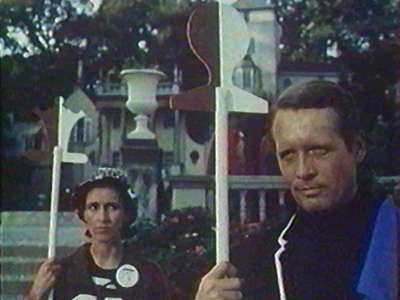 "Come be the queen's pawn"
 (Revised 01/03/2023)
Amongst the hours of television ever made, there are episodes of key series that combine theme, direction, music, imagery, and writing into a solid, almost Platonic ideal of their representative series: "Eye of the Beholder" from Twilight Zone; "Demon with a Glass Hand" from Outer Limits, and "Genesis of the Daleks" from Doctor Who.
During the midst of this match, Number 6 attempts to engage the Queen in an escape plan...but witnesses the Rook making an independent move...and the plot begins to move forward. We are soon caught in Number 6's plans to escape the Village, his learning about how the Village operates, and the subtle shadings of power that permeate all of the relationships in the Village.
One of the great aspects of this episode (which I never really appreciated until now) is the almost clockwork efficiency of the plot: soon, we learn why the Rook is on the island (he invented an electronic defense program which, naively, he felt every county in the world should know about), and Number 6 begins to use the Rook as part of his plans. It's also the first episode that moves from Cold War-style espionage thriller to allegory, as Number 2 proclaims, "In society, one is expected to conform." The Rook receives severe Pavlovian-style conditioning to deter him from independent thinking...and you would think that he would avoid Number 6...but as we learn, things are not always as they seem.
During this time, one of the Village scientists decides to utilize the Queen in a gambit - condition her to "fall in love" with Number 6, attach an electronic device to her, and she can serve as a tracker. (And to extend the chess metaphor, all of the characters - even Number 6, in an ironic way, at the end - perform very restricted, limited moves, and variation from those is dealt with.) Although it seems rather tacked on - and Number 6 catches on too easily - it's a gambit used to distract Number 6, to keep his attention away from the real game on the board; after all, the very technology in the Queen's locket fits Number 6's makeshift radio a little too well.
As the plot progresses, Number 2 - played by Peter Wyngarde (who would have later career problems after being "found out") - seems calm and dispassionate. Originally, I had never liked his portrayal, but watching the episode in isolation, I realize why he's so cold and aloof (except for a karate-themed outbreak towards the end)...after all, as in poker, a chess master never lets his feelings betray him during the game in play. Yet, Number 6 did - as the Wyngarde Number 2 points out, it was the former's "subconscious arrogance" that led the Rook to believe he was a warden and not a prisoner. By implication, Number 6 brought his failure upon himself - after all, had he not taken the initiative, Number 6 would have just been seen as another resident. However, Number 6 never counted that some people cannot, as stated earlier, tell "whose side" anyone is on.
Finally, the ending of the episode - the sequence in question begins 7:09 in this YouTube clip. It would have been easy to have the usual end-of-the-episode monologue; however, the direction and musical score help create a solid gut-punch to an episode that is one of the most multi-layered episodes in the series.
You sure didn't see this on The Mod Squad, that's for sure.
Coming soon: The episode has originally broadcast as episode two. The only two-time Number 2. And, of course, the obligatory "evil twin" episode...with a difference.
Be seeing you.
In terms of The Prisoner, that episode would have to be "Checkmate," one of the best-directed and well-scripted episodes of the series. Every line has a double meaning, every act seems to fit in place...and the ending is one of the bleakest ever done for a series set in the 1960s...and maybe in all of television.
The episode sets out its imagery at the outset - a huge chess game run by two individuals on opposing sides. Number 6, still relatively new, wishes to escape. If ever a show wore its imagery and themes on its sleeve, "Checkmate" does so almost five minutes into the episode. (It also expands on a key line from the first episode - "We're all pawns, m'dear")
There's a very telling conversation between Number 6 and the "Chessmaster" (an ex-count whose country used to hold such games...and the loser lost their heads. Literally), which sets the stage for the main theme of the episode, namely, the dynamics and duality of power:
Number 6: Why do you use people?
Chessmaster: Some psychiatrists say it satisfies the desire for power. 'the only opportunity one gets here.
Number 6:That depends what side you're on.
Chessmaster:I'm on my side.
Number 6: Aren't we all?
Chessmaster: You must be new here. In time, most of us join the enemy...against ourselves
During the midst of this match, Number 6 attempts to engage the Queen in an escape plan...but witnesses the Rook making an independent move...and the plot begins to move forward. We are soon caught in Number 6's plans to escape the Village, his learning about how the Village operates, and the subtle shadings of power that permeate all of the relationships in the Village.
One of the great aspects of this episode (which I never really appreciated until now) is the almost clockwork efficiency of the plot: soon, we learn why the Rook is on the island (he invented an electronic defense program which, naively, he felt every county in the world should know about), and Number 6 begins to use the Rook as part of his plans. It's also the first episode that moves from Cold War-style espionage thriller to allegory, as Number 2 proclaims, "In society, one is expected to conform." The Rook receives severe Pavlovian-style conditioning to deter him from independent thinking...and you would think that he would avoid Number 6...but as we learn, things are not always as they seem.
During this time, one of the Village scientists decides to utilize the Queen in a gambit - condition her to "fall in love" with Number 6, attach an electronic device to her, and she can serve as a tracker. (And to extend the chess metaphor, all of the characters - even Number 6, in an ironic way, at the end - perform very restricted, limited moves, and variation from those is dealt with.) Although it seems rather tacked on - and Number 6 catches on too easily - it's a gambit used to distract Number 6, to keep his attention away from the real game on the board; after all, the very technology in the Queen's locket fits Number 6's makeshift radio a little too well.
As the plot progresses, Number 2 - played by Peter Wyngarde (who would have later career problems after being "found out") - seems calm and dispassionate. Originally, I had never liked his portrayal, but watching the episode in isolation, I realize why he's so cold and aloof (except for a karate-themed outbreak towards the end)...after all, as in poker, a chess master never lets his feelings betray him during the game in play. Yet, Number 6 did - as the Wyngarde Number 2 points out, it was the former's "subconscious arrogance" that led the Rook to believe he was a warden and not a prisoner. By implication, Number 6 brought his failure upon himself - after all, had he not taken the initiative, Number 6 would have just been seen as another resident. However, Number 6 never counted that some people cannot, as stated earlier, tell "whose side" anyone is on.
Finally, the ending of the episode - the sequence in question begins 7:09 in this YouTube clip. It would have been easy to have the usual end-of-the-episode monologue; however, the direction and musical score help create a solid gut-punch to an episode that is one of the most multi-layered episodes in the series.
You sure didn't see this on The Mod Squad, that's for sure.
Coming soon: The episode has originally broadcast as episode two. The only two-time Number 2. And, of course, the obligatory "evil twin" episode...with a difference.
Be seeing you.
August 19, 2007
Sundays in the Village: Dance of the Dead
 Prisoner: Dance of the Dead
Originally uploaded by Gordon D
Prisoner: Dance of the Dead
Originally uploaded by Gordon D Doctor: Every man has a breaking point! Number 2: I don't want him broken...he must be won over....this man has a future with us.
(Revised 01/03/2023)
If "Free For All" dealt with Capital-P-Politics in the Village, "Dance of the Dead" deals with small-p politics - the ways in which the Villagers, each of different ranks, handle each other. It's an episode in which a great deal of information is imparted, and there's about a season's worth of Lost information provided in a nice, 50-minute block...and cleverly, as well.
It's time for Carnival, where there is "music, dancing, happiness....by decree." Number 6 runs into another old friend (Roland Walter Dutton) and a dead body with a radio. We learn that Number 2 fully believes that Number 6 is a "special" case...and that he will not easily be broken. (In fact, Dutton serves as a good counter to Number 6 - at the end of this episode, it's easy to see how Number 6's character compares to Dutton's). There's also an excellent theme about the interpersonal games that are played (hence the "small p politics"). A very flirtatious maid makes her way into Number 6's life. When provided his own tuxedo, Number 6 provides an excellent semi-punch line to Number 2's comment, "He's an individual...and they're always trying."
Towards the end, Number 6's "trial" is a game in and of itself, more allegorical than the plot - three of the main characters in the episode, dressed as infamous tyrants, judge Number 6 of being guilty of the crime of having a radio in the Village, and he is officially declared "dead." (Meaning - he's not welcome, and he technically does not exist. It's hard to do a straightforward review of this episode since it works on multiple levels, but (in my opinion) the ultimate theme is announced by a lonely voice on the radio, as Number 6 finds himself in a far corner of the Village, attempting to gain radio signals to determine his location. The voice announces, "Only through pain can tomorrow be assured," which works on two levels - both on the level of the mandatory frivolity of Carnival and amidst the various games that are played (ending with a move that informs Number 6 - and the audience - that nothing really is as it seems). Its ultimate message is that, to paraphrase a quote, some games are worth playing despite being unable to win...
However, one aspect of this episode - which will have to be explored when watching further episodes - seems quite jarring. It happens towards the end, with a quote that simultaneously defies and defines the themes of individuality within The Prisoner.
Number 6: “Never trust a woman; even the four-legged variety.”
Granted, this may be part of Patrick McGoohan's slightly out-of-it sense of chivalry; on Danger Man, his character of John Drake had a tendency to use brains over fists. (Of course, McGoohan thinks fist fights are better than love scenes, so go figure). A statement like this - given that Number 6 is in a situation where his individuality is threatened, the secrets in his head are his highest commodity, and the greatest need for him to "follow along" - is jarring; his slogan should be to never trust anybody.
However, two things contradict this statement, if only to provide further grist for discussion: the first is Mary Morris' performance as Number 2. At Carnival, she is dressed as Peter Pan; considering that the role was written for Trevor Howard, and that his costume would either be Father Time or Jack the Ripper, Morris does an admirable job. Personally, she's my favorite Number 2, mixing a pragmatic friendliness with a slightly menacing chill. (Her costume also seems slightly ironic - in a world where Number 6 is expected to "grow up", she is dressed as a character who embraces eternal immaturity). She doesn't seem at all dangerous or untrustworthy...which only makes her more so.
And, of course, the symbolism in Carnival may also have some play as well - Number 6, an individual who rallies against the status quo, is given his own suit and told that he is "dead."
Perhaps, in a way, McGoohan is encouraging all of us, regardless of our beliefs - from political and social reform to, for example, wishing for a memorial to a deceased comic character - to do so despite other pressures. In fact, by his own ironic adoption of the Village's techniques, Number 6 asserts the need for greater speaking out.
Coming in the next few weeks: "We're all pawns, m'dear" taken to the extreme. Number Two quits hunting down the Be-Ottles. And, for the first time, a Village two-fer.
Be seeing you.
August 12, 2007
Sundays in the Village: Free For All
(Revised on 01/02/2023)
Having failed to acquire the information through crook (i.e., the traitorous Cobb in Arrival), the new Number 2 decides to get it by hook - appeal to Number 6's sense of wanting change. Appeal to the sense of changing the system from within. And what better way than through elections? Encourage someone with an ambition that his best strategy is to get next to Number One...and be the power behind the throne?
"Free for All" had traditionally been televised fourth in the series - however, given that it was the second episode written and produced for The Prisoner, it makes much more sense to be second. (And for those who would argue that "Dance of the Dead" should be second, let me suggest that psychologically - and I will touch upon this next week - it is easier to ostracize someone who tries to upset the apple cart than it is to integrate a rabble-rouser). In addition, written by Patrick McGoohan, it is probably one of the more "conventional" episodes, with many excellent lines ("Are you planning to run?"/"Like blazes, the first chance I get"), just be seen as openly contemptuous of "democratic" processes, and the similarly aligned observations about those elected. It's also a meditation on how easily when given power, the noblest of us forget about the simplest truths about freedom and choice.
I have to admit that "Free For All" has some personal resonance for me, not just because I grew up in a city where politics was (and is) a contact sport. After I had moved to St. Louis, I was encouraged to run for the Steering Committee for a local group whose mission was to attract and retain young talent to the city. After losing two elections...for the same chair position....to the same opponent...I became a little jaded. (Of course, I ran three uncontested races and served for a year and a half). In time, after being "drafted" into serving as elections commissioner, with two sides deciding not to play by their own rules, I had enough and left the organization. The fact that I retain my name and am not exiled in Wales speaks volumes.
This is said to provide context - "Free for All" always resonated with the I'll-show-them spirit. The willingness to make a greater effort to change a perceived corrupt system. And through the episode, McGoohan shows that the Village is suspect. The current "council" is comprised of silent, still figures. After an abortive attempt to confront them, he is sent to a "civil servant" (who, according to one character, adapted to the Village rather quickly) who gives him a seemingly "telepathic" truth test. (Although it is a perversion of positive and negative conditioning - the Village powers-that-be assume Number 6's reasons and act accordingly). And throughout all this, Number 2 acts as an ally (a drunken encounter in a secret cave) and enemy (the resulting political speeches). In short, it's no wonder that the pub's name is the "Cat and Mouse" - McGoohan seems to suggest that politics is a cat and mouse game, with one person trying their hardest to vie for the votes - and approval - of the crowd. (At one point, when addressing his fellow residents, as Number 6 announces a policy of "Less work...more play", he - and McGoohan - share a smile that says I can't believe I'm actually getting away with this.
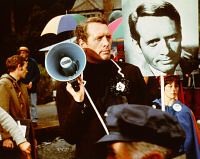
Number 2: We want information... information... information.
Number 6: You won't get it.
Number 2: By hook or by crook, we will.
Having failed to acquire the information through crook (i.e., the traitorous Cobb in Arrival), the new Number 2 decides to get it by hook - appeal to Number 6's sense of wanting change. Appeal to the sense of changing the system from within. And what better way than through elections? Encourage someone with an ambition that his best strategy is to get next to Number One...and be the power behind the throne?
"Free for All" had traditionally been televised fourth in the series - however, given that it was the second episode written and produced for The Prisoner, it makes much more sense to be second. (And for those who would argue that "Dance of the Dead" should be second, let me suggest that psychologically - and I will touch upon this next week - it is easier to ostracize someone who tries to upset the apple cart than it is to integrate a rabble-rouser). In addition, written by Patrick McGoohan, it is probably one of the more "conventional" episodes, with many excellent lines ("Are you planning to run?"/"Like blazes, the first chance I get"), just be seen as openly contemptuous of "democratic" processes, and the similarly aligned observations about those elected. It's also a meditation on how easily when given power, the noblest of us forget about the simplest truths about freedom and choice.
"Everyone votes for a dictator"
I have to admit that "Free For All" has some personal resonance for me, not just because I grew up in a city where politics was (and is) a contact sport. After I had moved to St. Louis, I was encouraged to run for the Steering Committee for a local group whose mission was to attract and retain young talent to the city. After losing two elections...for the same chair position....to the same opponent...I became a little jaded. (Of course, I ran three uncontested races and served for a year and a half). In time, after being "drafted" into serving as elections commissioner, with two sides deciding not to play by their own rules, I had enough and left the organization. The fact that I retain my name and am not exiled in Wales speaks volumes.
This is said to provide context - "Free for All" always resonated with the I'll-show-them spirit. The willingness to make a greater effort to change a perceived corrupt system. And through the episode, McGoohan shows that the Village is suspect. The current "council" is comprised of silent, still figures. After an abortive attempt to confront them, he is sent to a "civil servant" (who, according to one character, adapted to the Village rather quickly) who gives him a seemingly "telepathic" truth test. (Although it is a perversion of positive and negative conditioning - the Village powers-that-be assume Number 6's reasons and act accordingly). And throughout all this, Number 2 acts as an ally (a drunken encounter in a secret cave) and enemy (the resulting political speeches). In short, it's no wonder that the pub's name is the "Cat and Mouse" - McGoohan seems to suggest that politics is a cat and mouse game, with one person trying their hardest to vie for the votes - and approval - of the crowd. (At one point, when addressing his fellow residents, as Number 6 announces a policy of "Less work...more play", he - and McGoohan - share a smile that says I can't believe I'm actually getting away with this.
(EDIT - given the events of the past seven years, Free for All has greater resonance)
Ultimately, towards the end, there is a lesson that Number 6 forgets. After winning the election, he announces throughout the Village that they are "free to go, "...and they remain. Despite his promises, Number 6 forgets that freedom is a double-edged sword...and that the Villagers are also free to stay. (It's a sentiment that's prevented me from chastising some of my blogging colleagues when arguing about the possibility of universal health care or when a friend gushes over a candidate who spits out platitudes and promises).
In a slightly clever twist at the end, Number 6 is painfully reminded that there are various "ways and means" by which the Village will get the information in his head. He has drawn further attention to himself...and has branded himself a troublemaker.
The game has only started.
Coming in the next few weeks: Number 6 attends Carnival. The world's largest chess game. And, of course, Leo McKern.
Be seeing you.
Ultimately, towards the end, there is a lesson that Number 6 forgets. After winning the election, he announces throughout the Village that they are "free to go, "...and they remain. Despite his promises, Number 6 forgets that freedom is a double-edged sword...and that the Villagers are also free to stay. (It's a sentiment that's prevented me from chastising some of my blogging colleagues when arguing about the possibility of universal health care or when a friend gushes over a candidate who spits out platitudes and promises).
In a slightly clever twist at the end, Number 6 is painfully reminded that there are various "ways and means" by which the Village will get the information in his head. He has drawn further attention to himself...and has branded himself a troublemaker.
The game has only started.
Coming in the next few weeks: Number 6 attends Carnival. The world's largest chess game. And, of course, Leo McKern.
Be seeing you.
Subscribe to:
Posts (Atom)