Showing posts with label season four saturdays. Show all posts

December 27, 2008

Season Four Saturdays: The Next Doctor

(Some minor spoilers follow)

In all honesty, I would love to tell you that this year's Christmas special is a return to form for Russell T. Davies after the debacle of Journey's End. In fact, I can honestly say that 85% of The Next Doctor is nearly pitch-perfect, mixing equal parts pathos, comedy, and with a really creative premise that I doubt the original series proposed (unless there has been a Cyberman story set in the past that I've never seen)...in fact, if the sequence that happens 25 - 30 minutes in doesn't break your heart, it means either you're jaded, and/or you have no heart.
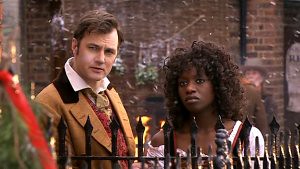
Our story begins in 1851 London, when the Doctor comes across a young lady named Rosita, who is in danger, and who is yelling for "The Doctor." However, much to his surprise, another gentleman - who calls himself "The Doctor" (and who we'll call "Doctor Next") arrives to help save the day. Thanks to a slight turn of events, our Doctor comes to believe that Doctor Next is his next regeneration. Of course, there is a complication with the Cyberman attempting to take over Victorian London...

...and most of the episode works beautifully. David Morrisey hits the right tone - almost as if he were next in line to take over from David Tennant. (No, I'm not speculating at all. I'm letting the rumors fly freely) It's a great takeoff on a classic Victorian adventurer, and Morrisey handles the role with aplomb, even with the script complications. For most of this episode, it's an almost pitch-perfect mix, probably the best since The Christmas Invasion (and definitely much stronger than last year's Voyage of the Damned).

However, and I'm going to try to talk about this without spoiling - the Cybermen's "big bad" is simply lame and unoriginal. It seemed more like Davies was trying to go over-the-top in light of Journey's End - I just was unconvinced. It seemed done more out of a sense of "let's-give-the-effects-guys-a-challenge" than a legitimate threat. But making it through that sequence leads to a touching, totally heartbreaking sequence...but one that suggests that this Doctor's journey will be coming to an end, and almost reads as if the Tenth Doctor has been - on some level - paying for the Ninth Doctor's sins in many ways.

If you get a chance to see it, do so. Just don't mind the wonky bits 47 minutes in.

July 19, 2008

Season Four Saturdays:Journey's End


(One or two mini-spoilers may be present)

So, after twelve weeks - from the Doctor and Donna's silent meeting to learning that the earth is gone, part of a huge cosmic engine, we have the grand finale.

Good news - there are some good, slightly fannish touches which I really liked.

Bad news - it makes last season's "Last of the Time Lords" look like tightly written drama in comparison.

First, the good touches - Dalek Caan, aka "the nutty Dalek". Everyone in the TARDIS control room. Mickey & Captain Jack's reunion. Sarah Jane's confrontation of Davros, and her reassurance that the Doctor has a "large family". Daleks speaking German (well, I liked it). Some plot points which hint at a slight repudiation/retcon of information from an earlier Doctor Who movie.

However, two things towards the end make it absolutely wonderful - Bernard Cribbins, as always, hits the sweet spot. But just before then, as the Doctor is talking to Donna's family, he makes a very straightforward - almost terse - remark to Donna's mother. It's the kind of Doctor-ish touch that seems to be missing from new Who. It's minor, it's relatively pointless, but it reminds us of the kind of character the Doctor should be - a moral compass, reminding us that we can, in fact, be better individuals.

Now, the bad...oh, brother. This episode brings out Davies' worst excesses, swimming in a stew of scientific implausibility, plot contrivances, and deus ex machinae. It falls flat because it becomes almost Who by numbers - the universe will be destroyed! Only the Doctor can save it! And, of course, last episode's cliffhanger turns into a handy way to resolve key story arcs, leaving us with the Doctor, alone...as usual.

Good example - Davros. Last episode, he taunts the Doctor, claiming, "The Daleks are my children...where are yours?" However, this episode finds repeated references to "the Children of Time", with Davros then claiming the moral high ground, stating that the Doctor "takes people...and turns them into weapons". Let me now postulate my first corollary to Godwin's law:
"If you did something truly and completely reprehensible, like create a race of killing machines like the Daleks, you immediately give up your right to the moral high ground when discussing other people's actions or lack thereof"
In other words, when I make fun of Mike Sterling for liking All Star Batman & Robin, his retort can be "Well...at least I didn't invent the Daleks!"

Am I being a little too anal about this? Possibly, but at least I'm not Lawrence Miles about it. It's sad that this was the most-watched show in England...and it could have been so much better.

This should have been a right and proper swan song for Davies, as his involvement with Who will end by 2010. (He has four specials to write, and then Steven Moffatt takes over Season Five). It could have brought the Doctor's arc - from war-weary survivor to transtemporal "father figure" - to a fine and fitting conclusion. This was a very strong season from the start, but unfortunately, ends with neither a bang nor a whimper, but a shrug, a tale full of sound and fury, composed from the bits off of cocktail napkins, coming to a blank, futile end.

And Who fans deserved better.

July 12, 2008

Season Four Saturdays: Prelude to Journey's End

Recently, a commenter had asked why my reviews were being shown out of sync, and I had to admit - I was kind of off-kilter with the Sci-Fi Channel's schedule. So, in an effort to help redress the balance, build suspense, and more importantly - help spread the gospel of classic Who.

Much like fellow bloggers/Whophiles Siskoid and Rich, I sometimes think new Who is enjoyed at the expense of classic Who. For me, classic Who is to new Who what a good stout is to American beer - you can enjoy both, but one is meant to be savored.

This season has seen a more conscious effort to integrate classic Who mythology (and just in time for the 45th anniversary!) - with its focus on moral choices, on paths not taken, this season draws very heavily from two classic Who stories.

The first is my personal favorite story - the one that got me hooked on Who in the first place (and quite frankly, the one where RTD is pulling most of this series' themes). Genesis of the Daleks is a story that is steeped in morality and ethics - in fact, at the very beginning, the Doctor is given a mission by the Time Lords: stop the Daleks before they become a threat. (Or, to use the old chestnut which is quoted, "If you could go back in time and kill a ruthless, evil person while they were a child - would you do it?") Characters spend time discussing choices - from removing emotions that would make the Mark 4 Travel machines more efficient, to hating someone because they're attractive - and somehow, it makes for thrilling drama. When the crucial time comes for a choice, the Doctor asks himself, "Have I the right?" - for many of us, it would seem an easy choice, but the ramifications (only hinted at in this season's "The Fires of Pompeii" seem monumental.)

However, a much earlier examination the Doctor's morality - and a crackling good story - can be found in 1973's Doctor Who and the Silurans. (Available both by itself as well as part of the Beneath the Surface boxed set). Set during the "UNIT era", this story tells the tale about a lost race of reptiles who evolved long before man...and who want their planet back. (The What Lies Beneath featurette helps place this story in a historical perspective). Throughout the course of seven (!) episodes, we see both sides - Silurian and human - debate whether they can coexist, or whether there needs to be wholesale genocide of another race.

I know, some of you are saying to yourself, "Gee, Gordon, these are long episodes - new Who fans won't want to watch these really long stories." But one of the advantages of these - the one which gives classic Who its edge - is that the Doctor serves as an absolute moral force. Granted, you can argue that the Time War made the Doctor's life ethically more complicated...but these are both stories where the Doctor seems to stand for value. Plus, at their extended pace (Genesis' six episodes, the Silurians' seven episodes), they allow for a much more thorough style of storytelling, and don't feel the need to cram a ton of detail into 45 or 90 minutes. (Yes, I'm talking to you, Stephen Greenhorn!). Plus, watching these shows is like enjoying a fine gourmet meal - you can like McDonalds, but sometimes, you want a nice, well-cooked steak. Or chicken).

But enough of that - I know, I know, you're all waiting for the season finale, unless you were smart enough to legally obtain it early. Since you have until Christmas for new Who - and only four specials in 2009 - this is your chance to help your new Who loving fans play catch up.

You'll thank me later. Honest.

Genesis of the Daleks: Highly Recommended
Doctor Who And the Silurians: Highly Recommended

July 5, 2008

Season Four Saturdays: The Stolen Earth

(I don't have to remind you that this is spoiler free, right? This is also post # 949 overall for the blog, for those of you counting)

In many ways, "The Stolen Earth" follows a similar formula to last season's "The Sound of Drums" - one immediate moment after another, building frenetically to a climax that has one wondering "how are they going to top this one?" In addition, there are many moments that are highlights from Davies' past run on Who, and that show Davies' love for the series...

....and therein lies the problem.

Yes, Davies pulls in The Sarah Jane Adventures, and Torchwood, and brings in Martha and Rose. He manages to build upon several themes from this past season, moving slightly effortlessly towards explaining-what-it-all-meant. We even get a slightly soppy reunion...but there's something about this episode that feels more like fan-fiction that total Who.

My frustration with this episode won't lead into a multi-page scribe like, oh, I don't know, a certain disgruntled Who writer with nothing better to do than complain. (Note to Mr. Miles - please come down from the cross; we really could use the wood). But the episode really lacks a solid heart - it's almost like Davies is attempting to get in every last idea he has about Who before allowing Stephen Moffat to take over. It even repeats a similar "If you believe in the Doctor, clap your hands!" moment from last time.

And Rose...I was disappointed. You would think that, after two years heading up Torchwood in an alternate universe, her character would be written as much more solid & mature. But that's just me.

However, there were some nice touches - Caan, the nutty Dalek. Captain Jack flirting with Sarah Jane. And, of course, Richard Dawkins.

I'll be watching, hoping to see how it all pans out. I only hope that Davies, in his haste to give Moffatt "a clean slate", doesn't throw out the Time Lord with the bathwater, to mix metaphors.

June 28, 2008

Season Four Saturdays: Turn Left

(This is going to be a spoiler-free review...and it's going to be the toughest review I've written so far. Keep reading for details...)

First, my overall review - I'm glad that, this season, Mr. Davies has disproven my "he-only-writes-two-good-scripts-per-year" theory.

I can't really discuss what goes on within the episode without spoilers...but I don't like spoiling episodes. I'm aware there are fan sites that do precisely that - and provide tons of speculation. I personally believe that it's much smarter - and helps make the case more strongly - to allude, to suggest, to tease the happenings in this episode. So, without further adieu, here's my take on "Turn Left."

Structurally, "Turn Left" is similar to last season's "Utopia" - great beginning, slightly muddled middle, and then a killer conclusion, setting the pace for the final two episodes of the season. It also builds on themes introduced early on in this season, picks up a meme that was recently introduced (actually several memes from recent episodes)...and, as Davies has promised, brings it all together, building a new narrative momentum. It also provides a great "recap" of events of the past three years to date.

And, also, it brings back Rose Tyler, which...I thought she was handled quite cleverly. Personally, I thought she was a better Ninth Doctor companion than Tenth. With the Ninth Doctor, this former shop girl brought a humanizing element to the character. With the Tenth, it was more of a "conventional" relationship. (Last night, I caught "The Idiot's Lantern" on Channel 11; although I liked a friendly Doctor/companion relationship, it seemed to verge dangerously into Baker/Ward territory).

But my favorite thing about this episode - Bernard Cribbins. He owns this episode, and quite frankly...I wish we'd seen more of ol' Wilf. Unlike the Tyler or Jones families, the Nobles seem to be one of the least dysfunctional (at least, as portrayed in this series - this episode, well, shows a different side). But much of it is due to (as Frank Miller might write) "the goddamn Bernard Cribbins". Yes, I'm aware he was in the 1960s Who films...but why can't Wilf be a companion? Come on, Moffatt!

But anyway...last season, "Utopia" gave way to "The Sound of Drums"...and fell flat with "The Last of the Time Lords".

I'm really looking forward to this season's end...but please don't be too upset if I'm a little cautious about it.

June 21, 2008

Season Four Saturdays: Midnight

(As always, a spoiler-free review. Nothing to look at here if you’re seeking plot points.)

I happen to admit that I have very mixed feelings about Russell T. Davies.

I’m grateful for his work in bringing back the series, and for some of his ideas…but in all honesty, he comes up with one or two really good script ideas per season.

First season, it was “Rose” and “Boom Town.” Then, “Army of Ghosts” and “Doomsday”. Last year, it was “Utopia” and “The Sound of Drums.”

Allow me to eat some crow this week, as after the charming “Partners In Crime”, Davies comes up with another out-of-the-ballpark hit with “Midnight”.

Amongst my Twitter pals, I had openly asked about why previous Doctor’s offspring had guest appearances, and I realized that this is the show’s 45th anniversary. Starting with last year’s “Time Crash”, this season has been steeped in Who mythology without being overly slavish about it. The Doctor without a companion is straight out of “The Deadly Assassin” with Tom Baker. The single locale for the episode is reminiscent of – William Hartnell-era “The Edge of Destruction.” Yes, there are elements of past stories…but one Doctor – an unexpected one – pokes his eager little head…

…if anything, “Midnight” could have easily been a Patrick Troughton/Second Doctor era story (albeit with a 21st Century Twist). Like many of Troughton’s stories, it is a self-contained “base under siege” story (usually done because most of 1960’s Who was filmed in Lime Grove Studios, and the effects were on the cheap)...contains some obviously chilling moments, and shows some of the darkness behind the Doctor’s seeming joviality. It even has Troughton’s son David in a supporting performance (which is, just vocally, chilling – it’s like the Second Doctor is in the room). And the director – no relation – is Alice Troughton, who directed several episodes of Torchwood.

The one performance that I want to highlight is Lesley Sharp. (She's the blonde on the left in the following photograph.It’s hard to talk about what she does without giving away the store…but as I watched, she looked familiar, and I didn’t know where I had seen her before. Thankfully…well, let’s just say that she’s worked with Davies before…and I blogged about it. The supporting cast does a quite splendid job in a story that asks more questions than it answers…and is probably one of the scariest Who stories of the new season.

(And considering how much I loved Moffatt’s two-parter, that’s saying quite a bit)

But ultimately, the one thing that is striking about this story is that, for the first time, the Doctor is not automatically “accepted”…in fact, in many ways, his usual behavior works against him. It’s hard to describe without spoiling the story (and you know what? I don’t mind seeking spoilers out for my own entertainment, but respect other’s wishes), but given the amount of foreshadowing from previous episodes (and the preview for next time)…things may not be looking good for the Doctor.


Keep watching.

June 14, 2008

Season Four Saturdays: Forest of the Dead

(As always, no spoilers. If you came here as the result of a Google search for "Doctor Who Spoilers", shame on you. Honestly. Why not just watch and enjoy it in real time?)

All I can - and will say - about this episode is that this is probably the best resolution to a two-part episode since the "Army of Ghosts/Doomsday" Season 2 finale.

It's a difficult episode to write about without spoiling, because one of the strengths of the episode is that it takes several set-ups from last week's "Silence in the Library" and flips them around. There's one clever use of television conventions to help convince the viewer that, yes, something is going on. A character who seems set up to be the "villain" of the piece is shown to have much more noble intentions than expected. Much is said by not being said at all...but is subtly spelled out in hints, in insinuations, and in the small details that may or may not be said.

However - and this is the only way I can talk about the episode - is that, in many ways, it resembles Moffatt's Series One two-parter, "The Empty Child/The Doctor Dances" thematically, if not structurally. In many ways, the Ninth and Tenth Doctors are mirror images of each other - the Ninth severely traumatized by his past, and aggressively acting it out; the Tenth burying impenetrable levels of melancholy beneath a jovial, almost manic exterior. But one of the key themes of the "Child/Doctor" is that, despite severe trauma, life and - and will - prevail. The Ninth Doctor's joy at exclaiming "Everyone lives - just this once!" is palpable, and the viewer feels it.

With "Silence/Forest", it gets flipped and turned into "Everyone dies....but not every day." Given the huge amount of foreshadowing about choices, about knowing the future, it would be easy to postulate about where the season is heading. (Of course, we could all be wrong about it). But in this story, the Doctor faces severe trauma - the kind of trauma that was only suggested by the Ninth Doctor's history. And a fake-out ending - an ending which has played fair with the viewer - reinforces what is probably the Doctor's main raison d'etre...that deep inside, the Doctor is a man who does not want to see people die...and who fights for life at almost any cost. And the final interchange between the Doctor and Donna is probably one of the most endearingly human - and honest - interchange between a Doctor and a companion.

There have always been turning points in the Doctor's history - many of which have been seen in the classic series. In many ways, this story shows another turning point in the Doctor's history...and is, thankfully, severely and delicately underplayed.

Good move, Mr. Moffatt, good move.

The franchise will be in good hands come 2010.

(Note - Episode 12's title has not been officially released. When I get around to reviewing it, I will - in the spirit of non-spoiling - make up a title for it. And again - shame on you for seeking spoilers)

June 7, 2008

Season Four Saturdays: Silence in the Library

(Another spoiler-free review, especially since spoilers are part of the plot. Will explain shortly).

God bless Steven Moffatt.

Granted, it is fitting that he will take over the reigns of modern Who in 2010 after Russell T. Davies leaves. He, as much as Davies, is kind of the architect of modern Who, taking its traditional strengths and building upon them. In fact, his scripts show an incredible imagination - from Season One's "The Empty Child/The Doctor Dances" two-parter (which contains the funniest - and most touching - scenes with the Ninth Doctor), to Season Two's "The Girl in the Fireplace" (with its duelling time lines) and Season Three's "Blink" (utilizing commonplace statues as a source for horror).

"Silence in the Library" - while it cribs from the latter two scripts (as well as some classic Who imagery), is one of the better scripts this season, picking up on some threads from - believe it or not - "The Fires of Pompeii".
Our story takes place between two different time frames - seemingly present-day Earth and, seemingly, a planet-sized library in the future. (An obvious cop to several prominent comics bloggers - well played, Mr. Moffatt, well, played). At one, a young girl's nightmares seem to be coming true; at another, people mysteriously disappeared, sealing off a facility for 100 years. There is, unusually, a relationship between the two...but what is it? How do the Doctor and Donna figure in? What will happen next?

The best thing about this story - at least, the first part - is that it builds upon traditional Who strengths. First, there's the idea that more questions are asked than answered - one criticism of new Who has been that it has sacrificed mystery for whiz-bang storytelling....here, there is a gradual build of questions, and things happen that almost require a second episode for resolution. The main idea behind the "big bad" (namely, shadows as "piranhas of the air") is a seeming retread of "Blink"...but the way Euros Lyn directs the episode makes is almost a casual mixture of horror and noir. Plus, the main setting at a futuristic library also seems rather appropriate - given that, long before Alan Moore wrote League of Extraordinary Gentlemen, Who tended to borrow heavily from literary sources, so much so that it's refreshing that books, rather than a high tech version of Project Gutenberg or Librivox, are considered a key commodity in the future.

But the main thrust of the story - and which the classic series only covered once - is "foreknowledge" of the Doctor's future, as suggested by the presence of Dr. River Song, played by ER's Alex Kingston. There are various hints about Dr. Song's role in the Doctor's "later" life...and quite cleverly, Moffatt also integrates the idea of "spoilers", or foreknowledge of the future. In short, there is one scene that seems to be a blatant spoiler...either that, or it's really poor foreshadowing. It seems clumsy, especially in light of the "cliffhanger"...but I am hoping that part two of this story, "Forest of the Dead", reconciles many of the plot lines from this one.

In short, after something as disastrous as "The Doctor's Daughter", anything that comes after it would be seen much more positively. Having watched "The Unicorn and the Wasp" again, I found myself liking it even more...and a great "calm before the storm".

Now that we've passed the midpoint of the season, everything will start coming together.

So bring on "Forest of the Dead"

Stay tuned.

P.S. I will be volunteering at Wizard World Chicago on Saturday, June 28th...so please, if you see me, flag me down and say "hello."

So, what do you think of this news, Doctor and Donna?

June 6, 2008

Season Four Saturdays Prelude: Mid-Season Trailer

Between "The Unicorn & the Wasp" and "Silence in the Library" - due to it being preempted by the Eurovision song contest - the BBC showed a special version of the Doctor Who trailer.

I'm posting it now rather than back when it was released because:
  1. I'm a completist
  2. It has spoilers a-plenty; and
  3. You'll dig it.
(And yes, if the Beeb determines that I'm infringing on their rights, this video will be pulled. Fair's fair)

May 31, 2008

Season Four Saturdays: The Unicorn & The Wasp

(With this review, I'm returning to the no-spoiler policy. No plot points will be discussed)

Now this is much better.

"The Unicorn and the Wasp" is the kind of story that, even if I felt evil enough to spoil, I wouldn't - it's that good.

Written by Gareth Roberts, who penned last season's "The Shakespeare Code", this episode doesn't cover unfamiliar territory in Doctor Who (our example: the Davison-era Black Orchid, the last purely historical story, coming to DVD in August). What it does do is a fine balance between humor and horror, between wit and suspense - and manages to do so without compromising one or the other.

It's also a pretty tightly written episode - it doesn't feel as if too much information is crammed into forty-five minutes. It has some genuine laugh-out-loud moments, at least one moment that feels like potential foreshadowing...and Christopher Benjamin.

That's right - the man who helped the Third Doctor fight killer apes and a mad scientist at a refinery. Who also featured prominently in one of my two favorite Fourth Doctor stories. Who was also very prevalent in The Prisoner. It's worth it just for his performance, straddling the line between blustering, self-parody, and charm.

However, this semi-historical story (featuring Agatha Christie and, by extension, the circumstances surrounding her mysterious disappearance) has done something that I never expected - it's made me want to seek out and read Ms. Christie's work. There's tons of meta-commentary, in-jokes, etc...yet it all doesn't seem unrealistic, or self-consciously clever.

All in all, a great episode. Do not miss this one.

And next episode, Steven (expletive) Moffatt - my favorite new Who writer - starts a two parter.

May 24, 2008

Season Four Saturdays: The Doctor's Daughter

(WARNING: Spoilers follow, with long-winded explanations as to reasons why this contains spoilers)

Personally, when I blog, I prefer not to include spoilers. Part of it is that I hate writing spoiler warnings, but quite frankly - I enjoy the challenge of being able to describe a work without needing to hit major plot points.

Unfortunately, I can't do that with "The Doctor's Daughter", because most of my quibbles hit directly on plot points . So, I have to spoil it, and I hate doing that. Even bad episodes deserve some measure of anonymity, some measure that allows for fans to make a decision for themselves. So if you do not want this episode spoiled, please feel free to move on, delete this from your feed reader, etc.

Of course, the short form is that I enjoyed this episode much better when it happened to Data...and was titled "The Offspring"....and appeared on Star Trek: The Next Generation.

Jenny, the Doctor's daughter of the title, really isn't - she's basically a glorified clone, created from the Doctor's genetic material. Yes, I am being a little fannish when I say this, but it takes away any real dramatic or emotional engagement - there's no real "punch" to the story. (Imagine an episode of My Two Dads minus Greg Evigan...on second thought, better not). There are some good scenes - some of the emotional fallout from the Last Great Time War, the implications that Time Lords are more than just biology, and Donna becoming more of a moral/humanizing element to the Doctor - but all in all, this is disappointing.

(In a way, I almost wish that Donna and/or Martha had been engaged to serve as a genetic "mother" to Jenny. It might have made for some more interesting dynamics, and some better storytelling choices. Even the departure at the end...lacks some punch)

It also has quite a few familiar - almost to the point of cliche - story beats. Let's count off the obligatory story elements that you'll see in this story:
  • The Conflict/War That Makes No Sense
  • The Denial That She's My Kid
  • The Splitting of Companions Into Two Different Camps
  • The "The Enemy Is Just Like Us" Parallel Scenes
  • The Inevitable Bonding
  • The Explanation That Seems to Make Sense, But Doesn't Really
  • Not One, But Two Moments of Noble Self-Sacrifice
  • The One Character That Still Doesn't Get It
  • The "I-Won't-Kill-Because-I'm-Better-Than-You-Are" Speech
  • The "She's Just Like Her Father" Moments
and so on, and so on....

Easily the most disappointing episode of Season 4.

However, next week's episode is a different story.

May 17, 2008

Season Four Saturdays: The Poison Sky

(As always, this is spoiler free. If you're looking for spoilers, you won't find them here. Now, go away, before we taunt you a second time)

And with this two-parter, Helen Raynor redeems herself slightly for last year's Daleks In Manhattan/Evolution of the Daleks two-parter.

It was, in many ways, a good attempt to try to show another aspect of a classic Doctor Who monster - however, the episode's logical consistencies, the rather broad portrayals. ("I didn't know he liked musical theater" anyone?), and its reuse of themes from throughout the new series made it fall flatter than week-old soda.

Like I said last week, I cannot be objective about UNIT stories - even ones I don't like have something about them that I can appreciate. However, despite some rather clunky storytelling choices in the episode, it is quite a fulfilling end to a two-parter...maybe the best ending since first season's The Empty Child/The Doctor Dances.

Ok, that's pushing it, but there are several really cool things about this episode. I'm going to bullet point them here, because it would be close to impossible to discuss them without ruining the episode:
  • Thankfully, an obligatory reference to Alastair Lethbridge-Stewart, which serves to reinforce the point that...this ain't your father's UNIT. Quite frankly, I would love to see more General Mace/10th Doctor stories...but that's just me.
  • A blink-and-you'll-miss-it moment that is confirmed in the end credits.
  • Some moments with both Donna and Martha that might seem like foreshadowing...but not in the way that you might expect. They were really good character moments.
  • The big Sontaran/UNIT battle - hooo, boy, was I jonesing on this. I so wished that 1970s Who had these production values...and this level of scriptwriting.
  • One of the key themes this season seems to be choices...and the Doctor seems to be gradually placed into making uncomfortable, uncharacteristic ones. Although there is a last-minute, almost obvious switch, it's...it would be good to see the Doctor come dangerously close to a bad decision.
  • I hate evil boy geniuses. Can we not use that plot device ever again?
  • The twist re: the Sontaran's "strategem" - it makes sense logically, but somehow, there's something in the way that it's revealed that seems hackneyed.
Personally, I'm looking forward to Dorian's take on this two-parter; like me, he's a Who fan who doesn't get obnoxious about it. (Or, in my case, "less obnoxious than most"). Fortunately, the series is going at a good clip - three excellent episodes and two fair-to-middling with no obvious clunkers (like, say, "The Long Game". Or "Rise of the Cybermen/Age of Steel". Or "Gridlock").

Next week, "The Doctor's Daughter". I hear it's going to crack the Internet in half.

May 10, 2008

Season Four Saturdays: The Sontaran Stratagem

(Just a reminder, especially since a recent spike in referrals to this blog has been "Doctor Who spoilers" - these reviews are spoiler-free. Sorry for the inconvenience).

Unfortunately, this is not going to be an unbiased review. In fact, I cannot claim any objectivity in this regard.

I am a total UNIT fanboy. My first Doctor was Jon Pertwee - a chance enounter with Day of the Daleks as a youth led me to fall immediately in love with the UNIT era. Yes, at times it's a little campy - and despite its calendar problems, a little dated - but I love this attempt to match Who more in line with its roots in 1950s British science fiction.

But "The Sontaran Strategem"...well, I'm hoping that Barry Letts and Terrence Dicks are beaming proudly, because this is a great 21st century updating of their approach, using current concerns about global warming and environmental safety and mixing in a healthy dose of typical Who touches.

A young genius has invented a way to eliminate harmful gases from car exhaust, and has been installed on many cars throughout the world. A reporter dies under mysterious circumstances....and the Doctor and Donna find themselves in the middle of a UNIT investigation.

One of the nice things about this script is that as the viewer asks questions, the Doctor asks those same questions. It's not a dumbed down script - in fact, up until the ending cliffhanger, it actually respects the intelligence of the viewer. There's a meeting between Donna and Martha that reflects the pathos of the Rose/Sarah Jane meeting, but without any sarcasm and contempt. (In fact, at one point Martha shares a very touching little speech, encouraging Donna in a way that I'm sure Martha might have appreciated had there been the opportunity).

There's also a great initial chemistry with the new "Brigadier", Colonel Mace - there is some acknowledgment of the Doctor's past, but in essence (and this is a kind of spoiler) - the Doctor's been drafted. It is refreshing, however, that a new Doctor/UNIT story would have - and need - a great tension between the Doctor's relatively pacifist/non-violent ways and UNIT's more militaristic stance. (Although some acknowledgment of Lethbridge-Stewart may be forthcoming in the second part, "The Poison Sky")

And of course, this episode reintroduces the Sontarans - a race that, quite frankly, never really engaged me. (Like many, I found it hard to take seriously a race who looked like walking Mr. Potato Heads). But the script actually takes them seriously - yes, they're small, but they're brutal. Geared totally for war. Unafraid of death. In fact, one of the big questions of the script is inherent in the title...but that would be telling.

There are, however, two small glitches - a war chant that threatens to break out into this song, and a cliffhanger that seems, well, too logical to resolve, but that's minor.

I love UNIT. And I loved this episode.

And now, because I can, a picture of Martha Jones in a tub of goo:

May 3, 2008

Season Four Saturdays: Planet of the Ood

(As always, this review is spoiler-free)

Continuing on from last week's sojourn to ancient Rome, the Doctor and Donna find themselves - totally randomly (at the Doctor insists at the beginning) at the Ood-Sphere. Realizing that he had some unfinished business with the Ood, the Doctor decides to get involved....

...I have to admit that I really didn't feel like there was any unfinished business with the Ood. After all, they seemed to another unusual race, with some suggested relationship (made explicit in this episode) to a relatively obscure Who alien. In fact, there really seemed to be no rationale to bring them back other than...well, they were there.

But this is an episode that, although structurally no big surprise, actually is quite touching in many ways.

Much of it is the thought that went into why the Ood are a slave race - and the explanation for the need for those spheres that come out of their mouths. (They're not just for translation - there's an actual physiological component, but that's pushing towards spoiling the episode). Suffice it to say, the Ood are normally "not" a servile race...but a peaceful one exploited by humans.

(Or, as the Doctor points out to Donna, 42nd century Earth bears a strong resemblance to our own times....but more on that after the next paragraph)

There's a quite touching - and sad - moment when Donna is allowed access to the Ood's experience...and she finds it a little too much to bear. The Doctor, on the other hand, does not have that choice, which feeds into the themes of morality and choices present in this series...in fact, this is probably one of the first times (at least, that I can recall) where the Doctor assertively states that he felt he "owed" a race a favor, that there was a sense of obligation to his travels....

...which makes the episode glisten a little bit more, and gives it a little bit more weight. Granted, there are some obligatory twists and turns, but they actually do some as complete surprises. The 21st-century-dress-in-the-42nd-century conceit actually makes sense given the themes (unlike Davies' using 21st century reality shows 500,000 years in the future). The last ten minutes - with a twist and another piece of foreshadowing- really help elevate this episode.

It's an OK episode with some nice touches, but something tells me the best is yet to come...

April 26, 2008

Season Four Saturdays: The Fires of Pompeii

(After much thought, I've decided that, much like my previous efforts on The Prisoner, I'm going to do a weekly review/recap of Doctor Who season four debut. As always this will be a spoiler-free review)

When I first saw the previews for The Fires of Pompeii, I have to admit, I had a slightly snarky attitude, and thought to myself, "You know, I think I liked this episode better when it was The Shakespeare Code".

Of course, thankfully, I actually watched the entire episode, and I have to say that, production value and script wise, it's one of the best episodes Doctor Who has done - in fact, the script is surprising in that it's the beginning of (what I am speculating) to be the most in-depth exploration of the Doctor's morality.

It begins with the Doctor and Donna arriving in Pompeii in 79 AD, just before the major eruption of Mount Vesuvius. Even within the pre-credits trailer are some clever touches - a slightly witty attempt at speaking Latin within the TARDIS' "telepathic circuits"; some sly references to past stories; and the beginning of exploring why the Doctor can interfere in some circumstances rather than others.

However, the script takes an interesting turn - it does become a treatise on the ethics of changing history...but more importantly, it soon becomes a great meditation on foreseeing the future. The rights of one species versus another. In short, despite its talk of the Doctor knowing about "fixed points in history" - as well as a hinted at sense that, as a Time Lord, he has a unique perception of time - it becomes not just a cliche, but a real exploration of the Doctor's ethics.

Ethics and morality have always been key themes in the series. The First Doctor declared, "You can't change history - not one note!". The Fourth Doctor asked, "Have I the right?" (to which the Seventh Doctor seemed to answer, "Yes, I do!") The Fifth Doctor once remarked, "There should have been a better way", and the Ninth Doctor spent his sole season dealing with the aftermath of not knowing a better way during the unseen Time War. But this is the first time - through Donna's eyes - that we are beginning to get a sense of the huge burden that the character carries - knowing what might need to be done, and knowing that there is a conflict between that and more "human" qualities. Underneath its lavish exterior, "The Fires of Pompeii" seems to indicate the direction that season 4 will be heading: not so much the "return of an old enemy", but moving towards some life-and-death choice for the Doctor (suggested a piece of slight foreshadowing which might have been effective...had it not been "spoiled" in the last episode).

I also have to admit that this is a personal favorite because it hit on my two teenage obsessions: Doctor Who and Roman history. From the mentions of household gods to the use of soothsayers...this is a script that I probably would have attempted to write as a teenager but failed miserably. It's an indication that series four may be the best, most tightly written season of DW since its reboot in 2005.

No spoilers, but some final thoughts: the main plot eventually reminds a viewer of a quote from the past Christmas special, and the last shot seems almost chilling in its implications.