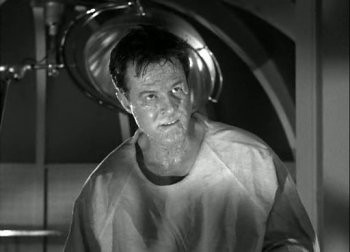
For sixteen episodes, we have seen a man - only identified as Number 6 - fight valiantly against the mysterious powers-that-be in an isolated Village. Now, after winning a psychological battle with his most determined counterpart, we now wonder...what was behind everything that happened?
What's it all about?
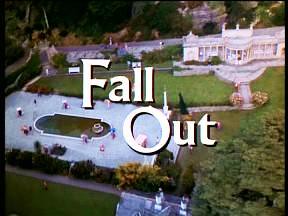
Fall Out starts differently - a three minute recap of
"Once Upon A Time" followed by a plain title card - but very quickly, goes nowhere. Admittedly conceived in a rush, it throws away any attempt at a straightforward narrative to move towards a more allegorical ending, and although its open-endedness allows for some debate, it doesn't quite seem to fit. In short, it's like a high school term paper cribbed from Wikipedia articles.
There are some excellent touches, and some really intelligent twists that, given further development, might have ended
The Prisoner on an even stronger note. Although many have cited the use of the Beatles' "All You Need Is Love", the episode's use of key lines make it almost ironic - McGoohan daring us to fight even the prevailing social movement at the time. McKern's Number 2 also has some key lines, including the very telling
"New allegiances...such is the price of fame...and failure." In short, the episode seems to suggest that Number 2, in his own way, was like Number 6, except he "resisted for so short a time" and failed to relinquish his number. (Plus, there's a
very clever in-joke at the end of
Fall Out)
The rest of the episode, however, falls extremely short. Number 6's "trial" seems more like an attempt to inject a sense of surrealism, the insertion of the song
"Dry Bones" a heavy handed effort to insert religious imagery...and the final 20 minutes seem to come from out of nowhere. The last-minute nature of the writing and directing of the episode shows, and it's a frustrating view not because it doesn't directly answer questions...but because there's little internal logic to it. (To be honest, the hint of the cyclical nature of Number 6's struggle is a well-deserved stroke of genius, reminding the viewer that the struggle for freedom never truly ends). Although the episode initially sets up a typical James Bond-ian moment to meet "Number One", the viewer senses that this is all an extreme, well-planned, staged psychodrama...

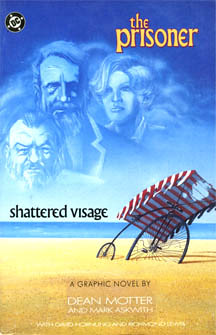
....which is the assumption that 1988's graphic novel,
The Prisoner: Shattered Visage (non-affiliate link) takes in its narrative. Although many fan sites like the Unmutual seem to disregard it (and I suggest checking out the
Unmutual page, as well as the
Anorak Zone Guide to the Prisoner, as two excellent Prisoner sites), the novel acts as more of a bookend than a full-blooded sequel. (In fact, both
Steve Englehart and
Jack Kirby had attempted to adapt the series in comic book form, with admittedly mixed results) However, it provides not only a great analysis, but even creates some further questions.
Thomas Drake (who is a slight nod to the show's
Danger Man roots, but also a link to
Sir Francis...and possibly this
little-known historical figure) has helped the McKern Number 2 write a book entitled
The Village Idiot. In addition, Thomas' slightly estranged wife Alice (
yes, it's an obvious nod) decided to go on a world sailing expedition, but finds herself stranded on an unusual island...with a very familiar face...
Although Dean Motter's writing is superb - drawing disparate elements in a story that often feels like episodes 18 - 22 of the original series, Mark Askwith's art is...well, at times I found it unreadable, and needlessly abstract. Although it is an honest attempt to convey the shadowy, abstract world of the espionage field, it doesn't quite work at times, often looking garish and jarring. The story, though, better integrates some of the religious imagery that McGoohan was attempting (such as speaking of "Archangels" and "Gods"), reintroduces us to some old friends, and also reinforces the McKern-Number-2-as-failed-Number-6 archetype in one key sequence.
But the most clever part of
Shattered Visage is how it integrates the sloppiness of
Fall Out into its story, but makes it a key character moment for Number 6. By suggesting that
Fall Out was staged so that Number 6 would, in effect, defy his own belief structure and take on a number, Motter suggests that no one really is fallible...and allows Number 6 to truly
become a prisoner. In fact, his psychological disintegration - and the fact that Number 6 actually lost the war - makes
Shattered Visage a good read for those who want to see a semi-satisfactory conclusion.
Towards the end, Number 6 makes a statement that, well, seems chilling in its implications - when asked who Number One is, he simply asks,
"Does the presence of Number Two...require the existence of Number One?"
Just think about it...
But I'll end this entry with a close-to-the-end exchange, which answers nothing - and everything - at the same time:
"But what about your information...your secrets?"
"Safe"
"How can you be so certain?"
"None of us would be here if they weren't"
When I took on this effort several months ago, I never realized how tough it would be - most of the series is pitched at a high level, and requires a great attention to detail. The almost manic, paranoid tone can be a bit grating - if you are desiring to watch the series, my suggestion is watching it one or two episodes at a time, preferably over a series of weeks. Since it is available for free via
Shout Factory TV and
Tubi (with ads, but a good ad blocker can help), accessing the series is much easier than ever.
However, even though the attempts to revive
The Prisoner seem to be faltering (and the current WGA strike may have further impact on its development), I believe that updating the series is not only important - but necessary. Some of the episodes (such as
The General) are beginning to show their age, but more importantly - there is a need for a lone cry of rebellion, of asserting indivdiual freedom, and of challenging the forces that attempt to claim our spirits, especially in the wake of 9/11. Never more in our "everything-is-out-in-the-open" times do we need a voice telling us to reclaim our lives, and that the fight for privacy and personal integrity is more than just a good idea - it's what makes us human, and is independent of time frame.


 helped immensely, and it's also available for







 casts a long shadow.


 of the BBC show
  I'll even go so far as to say that the George Clooney
  and the
  have aspects of this book integrated into their plots.


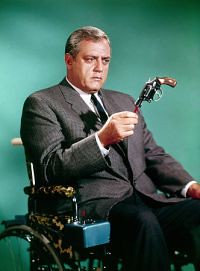
 , it's easy to think of this as another run-of-the-mill detective show. In fact, the early 70s seemed to have a ton of detectives on television. I think that it might have been a reaction to lawless times...but I think it's just more that they wanted to do contemporary Western-style shoot-em-ups. In fact, if this show were made today, it would be a high concept show -



 at a key moment.) Towards the end, it even takes on some slightly Pythonesque
 touches, from Number 6 dressing like Sherlock Holmes to the villain's
  episode, it has a rushed feel. (I am not suggesting that this would work as a two-parter; mostly, there could have been better choices in how edited material was handled. As it stands, at this point in the series' production, there was a mad dash towards the end. The fact that several key components - as well as
 comes out, it will undoubtedly (as it was when published) be compared with the
  ". (Much as the Heroes season closer is seen as an homage to Watchmen).