Showing posts with label popular culture. Show all posts

March 23, 2015

THE ARMSTRONG LIE and Noble Cause Corruption


Sometimes, we willingly engage in a "big lie": we see a situation for what it is, and are unwilling - or unable - to accept some more unpleasant truths. Those truths sometimes revolve around the idea of "noble cause corruption" - that people with noble causes sometimes engage in behaviors that can potentially short-circuit their efforts.

The documentary The Armstrong Lie takes on both - focusing on Lance Armstrong's 2009 Tour de France "comeback"....and reframing it within the context of his 2013 admission that he used performance-enhancing drugs.

Watching the film, I was impressed by director Alex Gibney's ability to focus on individual and situational complexities yet laying them out in a straightforward manner. His other films (including Enron: The Smartest Guys in the Room and Client 9) have focused on moments in contemporary history where self-delusion and destructive behaviors often have great impact on the cultural fabric at large. The Armstrong Lie does one better - Gibney implicates himself (and readily admits this in the commentary).

The film is actually two films - an abortive 2009 documentary called The Road Back (which had been shelved due to then-present allegations) and a follow-up to Armstrong's infamous admission of "doping" to Oprah Winfrey. Exploring the various ways in which this story unfolded (and allowing the 2009 footage to provide slightly ironic commentary), The Armstrong Lie really makes the case that for some, self-mythologizing and self-delusion often work hand-in-hand. Some stories are built on a lie, but taking that lie to its ultimate extreme - where the lie takes on the tenor of truth - can be the greatest character lapse.

Gibney allows Armstrong and several others - critics and colleagues - to tell their own story. But the strength of The Armstrong Lie is that Gibney reiterates the basic deception at the heart of this story. Towards the end, Gibney provides a closing narration that helps solidify the major themes of the movie. He also provides some insight into Armstrong's character - that a man who came back from a horrendous health situation may make that part of his narrative. And that may not necessarily be the smartest move for an athlete.

Good documentaries do more than just describe a situation - they create a context and a narrative that reaffirms human truths. Regardless of your feelings about Armstrong's actions, The Armstrong Lie makes a strong case for greater skepticism and exploration, especially when the narrative mixes the personal with the professional.

A must-watch.

March 15, 2014

To Educate You Further: The Ides of March

Yes, today is the Ides of March - not the band that popularized this tuneful little ditty:

But a day which has significant historical and cultural importance:


Know the difference.

(And that, readers, is today's lesson in cultural literacy.)

November 3, 2013

Review: I AM BRUCE LEE


Most documentaries about individuals work towards a more linear proposal - person is born, grows up, becomes famous, trouble ensues, etc. (Think of it as the Behind the Music approach to storytelling). One of the great aspects about I Am Bruce Lee is that it not only provides a clear narrative, it puts his life and work into a really wide perspective.

In other words, readers, if you think all Lee did was kung fu movies....you're in for a pleasant surprise.

Granted, it would have to be - besides actors and directors, a large number of athletes and professional martial artists discuss Lee's life and career. As a Bruce Lee fan myself, the documentary had me watching it repeatedly - not just because it features clips of his movies, but because it really delves into Lee's personal philosophy, and work ethic....and really shows Lee as more than just a great actor and athlete: it really shows how he was a "Renaissance man".

(And if you need an example, take a look at how Brain Pickings discusses Lee's concept of "being like water". It's so good, I wish that I had written it)

There are several really great highlights, including footage from Game of Death, Lee's uncompleted final film; great footage from Lee's past as a child actor; and some really interesting perspectives from a variety of unlikely individuals. (Al Bundy is a martial artist in real life? Who knew?) The only major misstep - and one which threatens the overall arc of the film - is when one individual claims that Lee "invented" mixed martial arts. Discussion about that particular subject - probably spurred more by a production entity than anything else - seems to be unnecessarily distracting, and doesn't really go anywhere. Focusing on Lee as an athletic role model is one thing; this particular discussion appears more self-serving than anything else. Thankfully, I Am Bruce Lee quickly moves through this conversation, and gets back on track. (Surprisingly, it even covers some of the conspiracy theories around his death, and Lee's widow puts it into perspective. This sequence is a must-watch, if only because it deserves to be seen).

Bruce Lee accomplished much in his short life, and his films show a man whose fighting style shared a hard-hitting impact and stylistic grace simultaneously. Action films of the past 40 years owe a stylistic and spiritual debt to Bruce Lee's work....but more importantly, there is a much deeper underpinning to his work. I Am Bruce Lee is undoubtedly one of the best pop-culture documentaries in current memory, focusing as much on Lee's intellectual and spiritual pursuits as it does on his movie and television work.

This is more than just a great way to pass the time - it's a very casual, yet penetrating look into a key aspect of popular culture. It's also mandatory viewing.

A

June 28, 2013

Richard Matheson: An Appreciation

When I was a child, I had a tendency to not just watch a lot of television....but I paid attention to the credits. For me, names like "Gene Roddenberry" and "Michael Garrison" were just as important as the stars.

When it came to The Twilight Zone, there were three writers who popped up frequently: Rod Serling, Charles Beaumont, and Richard Matheson.

I was saddened to hear about Matheson's recent passing; after all, I had some memories of Serling (via Night Gallery), and Beaumont via the now long out-of-print Howling Man collection. Matheson, however, was one of the more easily "discoverable" authors that I read.

Yes, he wrote horror, but not the kind of neo-Gothic or Lovecraftian pastiche that might have been prevalent. Matheson's work was grounded in real-life, whether it be the faceless truck driver in Duel (which scared the whatever out of me as a child) or the great reversal in I Am Legend (do yourself a favor and read the book; ignore the Will Smith movie, it's ok if you do so. I won't blame you).

One of the advantages of an author's passing is that he (or she) often leaves a treasure trove of great writing to enjoy. The best way to honor Richard Matheson - buy or borrow (from the library) one of his books.

March 26, 2013

Give Me That Old Time Television

One of the advantages to the recent digital tv switchover is that, much like cable, there is a greater variety of choices. (Unlike cable and other providers, it's free....with a converter box). What I've noticed in the time that I'm spending with television is that a variety of channels providing "classic" television has erupted.

With names like "Cozi-TV", "Me-TV", "Antenna TV" and "Retro TV", these channels might be seen to be a dumping ground - a great opportunity for purchasing low-cost content to show in between infomercials  (In fact, the target demographic seems to be aging Boomers and possibly aging Generation Xers). Some of the selections may be a bit obscure on other channels (Route 66? The Real McCoys?), but these channels deal heavily in nostalgia...and they do themselves a disservice, because they're a great education into how television used to be produced.

And no, that's not nostalgia from a guy who's being targeted by these shows. (I mean, let's face it, Cozi-TV has won my heart by mini-marathons of Lee Majors and Lindsay Wagner doing superheroic things in slow motion). In our current content-driven media culture, it would be easy for the younger set to get enmeshed in the high drama, overamped arcs, and continuity-driven storytelling, having done-in-one-episode stories seems exceptionally quaint...yet, there's a strength to the writing on several of these older shows. (There's also a greater flexibility in the performing - after all, two channels highlight the dramatic work of Bill Cosby - yes, I typed that out loud, and quite honestly, proved that he was more than the sweater-wearing pudding-pop salesman of the 1980s).

Ironically, these channels have me revisiting (in between writing bursts and job search efforts) two of my favorite shows: The Wild, Wild West and Ellery Queen...and has me appreciating the craft both shows bring. Neither one of them is "classic" television, and there's no whiff of nostalgia with Queen (I barely remember it as a child, and only began appreciating it via reruns on A & E in the 1990s), but both shows - much like the fare on current digital channels - demonstrate a kind of literacy that is largely absent from contemporary pop culture - concise plotting, well-drawn characters, and a willingness to engage the intelligence of the average viewer.

It's ironic - as I think about these channels, I'm reminded of summers with my paternal grandparents, where I would sneak downstairs while both napped, turn on the ancient black-and-white television (which needed to warm up first!) and watch reruns of shows on WGN and WFLD. It's great to know that some child, flipping channels, will now receive a pop culture education similar to my own.

January 3, 2013

What Happens AFTER PORN ENDS?


(FULL DISCLOSURE: a screener DVD was provided gratis for purposes of review. My opinions are my own). 

One of the more disturbing aspects of American culture (including popular culture) is the duality of our opinions and perspectives - we celebrate those who achieve, yet will denigrate those who do not try 'hard enough'; we will worship mediocrity while complaining about a lack of excellence; and we will publicly renounce resources that we privately enjoy.

I'm talking, of course, about pornography, and writing this post is a little challenging - I'm writing about a great documentary entitled After Porn Ends, and because of one single word, my view rates will go through the roof, but people will click off this post when they see it is not porn, which is a shame....because this is one of the more fascinating documentaries of recent years.

Focusing on the lives of former porn stars, After Porn Ends discusses adjustment to life after working in the field. Thankfully, the documentary takes neither an excessively moralistic or judgmental tone, allowing former (and current) porn actors and actresses to comment honestly about their lives, their motivations for entering "the business", and the impact on their lives after their careers ended. Be warned - there are some very NSFW moments in the film, but the ones that are the most moving....are the ones that rely solely on visuals.

The actor who has regret in his eyes over not having a "normal" life. Random shots of children's toys laying around a room. A woman with her husband and child. The kinds of images you would not normally associate with pornography, but that seem all the more vulnerable, revealing...and naked.

As with documentaries like this, there are some well-needed perspectives, mostly in balancing out some of the more traumatic stories with those that are a little more settled. But  rides a critical edge, revealing more about the motivations of industry participants - and their ability to live with the implications after leaving the industry - without engaging in black-and-white thinking.

After Porn Ends is one of those rare documentaries that not only moves you, but encourages you to think a little differently about an industry outside of the mainstream. Regardless of your positions about porn, you will find a great deal with value about this documentary.

After Porn Ends is available on DVD and Netflix streaming, and well worth viewing.

April 17, 2012

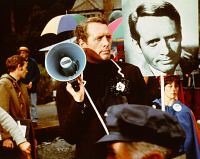
The New Number Six

Via Flickr
(Minor spoilers for the book The Hunger Game may be present. Consider yourself warned)

Recently, I read The Hunger Games - partially out of wanting to prepare for the movie (thanks, Nerd Girls' Eye View podcast!), but mostly because I had heard so much about it - a strong protagonist, a great premise, and really, I think that - in a strange way - this book (and I have yet to read the two follow-ups) resonates for me....the same way that The Prisoner did when I was younger.

Granted, it seems like a really tenuous connection, but please bear with me.

Both deal with a person who finds themselves - by their choice - involved in a very dangerous no-win situation. (Number 6 resigns, and finds himself captive on an island; Katniss volunteers to participate in the games to protect her younger sister). Both characters demonstrate an unwillingness to embrace the status quo, and in fact act out against it. (Think of Katniss' stray arrow shot in the Capital). Both participate in a flat-out war against their fellow "participants", and at the end...there is a question of whether they really have succeeded.

But what really sells the comparison (for me, at least), is that The Hunger Games doesn't just sell a superficial fight-the-powers-that-be tone; it absolutely embraces it. Granted, it may reflect the tone and themes that many young adult novels take on, but unlike, say, Twilight, there's a willingness to take an absolute moral stand. (It's like the old joke - if Harry Potter is about taking a stand and making good choices, Hunger Games is about not falling into the trap of cliches, and Twilight is about angsting over whether your boyfriend really likes you). 

But flat-out encouraging an anti-establishment attitude amongst young people? That, dear readers, takes all-out courage. During production of The Prisoner, McGoohan was a less-than-friendly presence, almost obsessive in wanting to be sure that his creative vision came through and that this tone was maintained. Although writing is a more solitary pursuit, Suzanne Collins maintains a similar consistency of tone....and The Hunger Games, as a book, is a pretty daring piece of work.

And in these times, when conformity and being "part of the crowd" is becoming more prevalent (increasingly, from my perspective, in the "geek/nerd" crowd), that we need art that reminds us that ultimately, we can stand for someone. Forty-some years ago, it was a man with a number. Today, it's a girl named Katniss.

And I hope that there's some young person embracing their individuality in the same manner that Number 6 encouraged me to embraced mine.


March 15, 2012

Beware.....the Ides of March!


... And if the idea of Ryan Gosling doesn't scare you...beware these Ides of March....


(For me, that joke never grows old....)

But somehow, somewhere, I don't think Shakespeare could conceive of this as an excuse to beware the ides of March (NSFW):


And here's what Wikipedia says about the Ides of March....